
AI is serving us brunch and flying drones, composing love songs, generating entire SaaS platforms, diagnosing diseases, and maybe even planning its own startup. Meanwhile, in the shadows of modern tech… PHP is still alive, running nearly 77% of the web, and it owns the place.
Why?
How??
Should we be concerned??
Did someone forget to tell PHP it was supposed to retire?
I mean, even Clippy got a glow-up, but PHP? Still here. Still functional. Still refusing to die. Some developers call it a “zombie language.”
Others call it “that one ex you keep going back to even though you _swore_ you were done.” One guy on Reddit said,
PHP is like duct tape: ugly, messy, but damn, it gets the job done.
Another Tweeted:
Using PHP in 2025 feels like riding a horse to work—it’s not wrong, but people will stare.
And here’s the language creator, Rasmus Lerdorf, staying humble:
“PHP is about as exciting as your toothbrush. You use it every day, it does the job… you don’t think about it very much.”
“If PHP were a car, it would have airbags that immediately killed the passengers upon impact.”
— Rasmus Lerdorf
And honestly? I get it. I’ve read the memes. I’ve lived the memes.
So yes, I’d love to be biased—really, I’d rather cheerlead for the shiny new AI stacks. But unfortunately, the data just won’t let me lie to you, and it sure as hell doesn’t take bribes.
Who Should Read This?
- Backend devs wondering if PHP is still relevant
- Startup founders choosing a tech stack
- Devs curious why PHP won’t go away
- Anyone who once said “PHP is dead” and now has a Laravel job
Who am I?
Hi, I’m Sagar Baghel — Laravel Developer, PHP Defender and Certified Bug Whisperer. I’ve been wrangling Laravel for over 5 years, and for the past 3, I’ve been proudly typing semicolons at eLEOPARD.
In short: I write code, I debug bugs that weren’t my fault (probably), and I still believe PHP isn’t dead—just aging like a fine wine… in a plastic bottle.
Yes, I still write PHP in 2025. No, it’s not because I hate myself. And no, I don’t need you to ask me if I’ve tried “that other framework,” because I have. Twice. And I’m still here (thanks to Laravel).
People say “PHP is dead.” Cute. Meanwhile, half the internet still runs on it, and I get paid to keep it alive—one elegant controller at a time.
This blog isn’t a tutorial. It’s a rollercoaster: half confession, half comedy, full-on chaos. I’ll roast PHP, love Laravel, drop some truth bombs, and maybe—just maybe—convince you that old dogs don’t just learn new tricks… they run the server.
The Accidental Language
(AKA: The Language That Was Never Supposed to Happen—but Now Runs the Internet)
Let’s rewind to 1994.
While the rest of the world was busy dialing up the internet and trying not to tie up the home phone line, a Danish-Canadian programmer named Rasmus Lerdorf just wanted to keep track of who was visiting his online resume.
That’s it.
No ambitions.
No dreams of building the backbone of the modern internet.
He literally just wanted a digital guestbook.
So, like any pragmatic nerd, Rasmus whipped up a bunch of C scripts to log traffic—and called it Personal Home Page Tools. (Admit it: even the name sounds like a school project that accidentally worked.)
But then… developers saw it. Played with it. Started asking questions like:
					| “Hey, can I use this for my own site?”
| “Can I hook it into a database?”
| “Can I do that cool dynamic thingy you’re doing?”
And because devs can’t leave anything alone, PHP started evolving. Fast.
It snowballed from “my little tracking script” into “huh, this looks like a language now” into “whoops, this thing runs **half the damn internet**.”
Even Rasmus admitted:
| “I don't know how to write a programming language. I just kept adding the next logical step.”
The Cold, Hard (and Funny) Data
Okay, time to be serious.
Just kidding. I’m a PHP developer. “Serious” left the chat around the time someone nested 6 `foreach` loops in production.
But seriously, let’s talk numbers. Because while everyone’s out there yelling “AI this” and “Python that” and “bro, PHP is dead,” the actual data is sitting in the corner like:
| “LMAO. You wish.”
| PHP Still Owns the Web
As of this year, PHP powers over 73.6% of all websites with a known server-side language. Yeah. That’s not a typo. Three out of four websites.
So next time someone says “PHP is outdated,” just ask them if they’d like their bank, blog, or billion-dollar CMS to spontaneously combust.
source: https://w3techs.com/technologies/overview/programming_language
source: https://w3techs.com/technologies/cross/programming_language/ranking
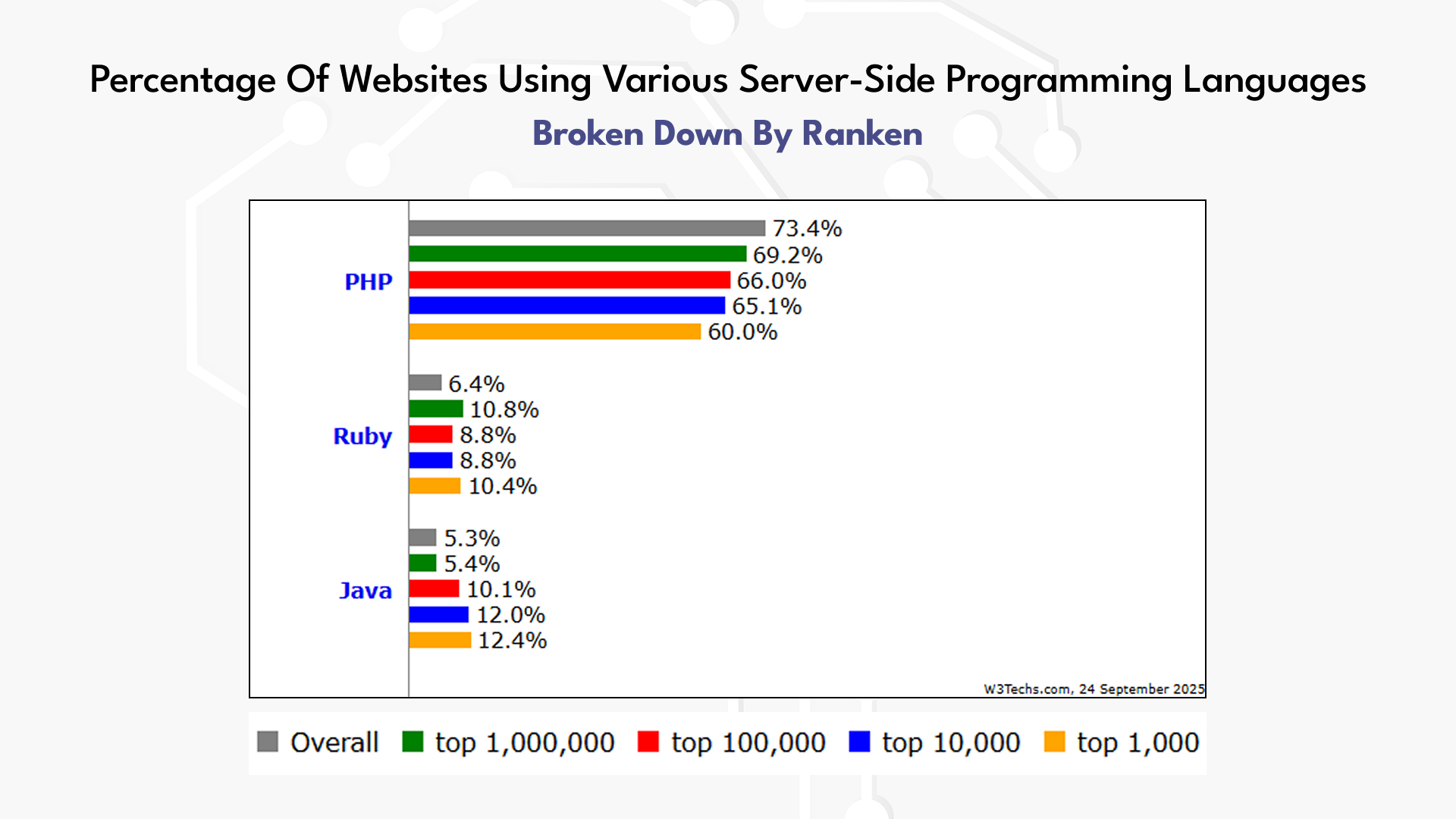
| "73.6% of websites whose server-side language we know use PHP."
Sounds impressive, right? Almost too good to be true.
Well… welcome to the fine print.
Let me break it down like a PHP array inside a foreach inside a callback inside a controller (you know the drill):
- That 73.6% stat doesn’t mean all websites on the internet use PHP. It just refers to websites where we can actually detect the server-side language.
- Many modern setups—especially SPAs, headless CMSs, Jamstack sites, or sites behind CDNs—hide or mask their backend tech.
- So, there’s a huge chunk of the internet that says: “Server-side? Never heard of her.”
(Mostly because they’re busy pushing everything to the frontend and pretending backends are optional.)
In other words, PHP might not literally power three-quarters of the internet — but it does dominate among sites where backend tech is visible.
Pros & Cons of PHP
Pros of PHP
1. Ubiquity & Legacy
It’s everywhere—WordPress, Drupal, Magento—and businesses aren’t paying to rewire what already works
2. Easy Deployment & Hosting Bliss
PHP just works out of the box on most shared hosting. Node.js might have a syntax swagger, but PHP has a host-and-play ease.
3. Massive Talent Pool
Hiring PHP devs is as easy as brewing chai. Compare that to scrambling for unicorn Rust or Go developers.
4. Modern Features
PHP’s no fossil—named arguments, union types, attributes, strict typing, JIT… it’s modern.
5. Strong Framework Ecosystem
Laravel, Symfony, CodeIgniter… these frameworks give structure, elegance, and swagger to PHP devs.
6. Security Upgrades in PHP 8+
Password hashing, CSRF, and XSS prevention tools—modern PHP is leaning into security
7. Cloud & DevOps Ready
PHP plays nice with Docker, Kubernetes, and serverless platforms, making it future-aware.
Cons of PHP
1. Reputation of Being “Old-School”
Some devs shy away: “PHP? That’s ancient!” – a stigma that persists despite the upgrades
2. AI-Generated Code Can Be Risky
If you let an LLM write your PHP, don’t forget the bug-spray: 26% of AI-generated PHP sites had exploitable vulnerabilities
3. GitHub Popularity Isn’t Skyrocketing
PHP hasn’t seen massive growth on GitHub; the trend is flat or slightly declining vs. rising languages like Rust or Go
4. Not Ideal for Heavy AI/ML Work
For hardcore data science or deep learning, Python wins—PHP is better suited to fast web logic, not neural nets.
PHP's past comebacks from the grave
Absolutely — PHP has had more comebacks than your favorite rock band.
Let’s dive into some key moments in history where people declared PHP “dead,” yet it rose like a phoenix covered in semicolons.
1. The Rise of Ruby on Rails (2005–2010)
| "PHP is over. Rails is the future."
Ah, yes, Ruby on Rails — the framework that promised developer happiness, convention over configuration, and endless memes. When it dropped, Rails was the new shiny toy everyone thought would crush PHP. It had:
- Convention over configuration
- Built-in ORM (ActiveRecord)
- Scaffolding magic
- Memes (lots of them)
The prediction: Rails would dominate web development.
The reality: Rails became popular, yes — but PHP still powered WordPress, Joomla, Drupal, and most custom websites globally. PHP didn’t budge. In fact, PHP grew faster thanks to shared hosting.
| Fun fact: In 2010, Rails usage was under 1%, PHP still ruled with over 70%.
2. PHP 5.x’s Dark Ages (2005–2014)
| "PHP is garbage. It's untyped and insecure."
During this time, PHP:
- Had no strict types
- Was error-prone and inconsistent
- Had no standard package manager
- Had a messy global namespace
Stack Overflow was filled with PHP jokes. Reddit devs laughed at mysql_query() like it was a bad meme.
The prediction: PHP will be replaced by Python, Java, or even ColdFusion (lol).
The reality:
- WordPress exploded in popularity
- PHP 5.6 got _decent_ features
- Cheap hosting meant PHP remained dominant
| Even while getting mocked, PHP was quietly powering 80% of the internet.
3. The Node.js Hype Train (2011–2016)
| "Why use PHP when JavaScript can run everywhere?"
Node.js promised one language on both frontend and backend. Devs got excited:
- Asynchronous I/O!
- Streams!
- NPM everything!
The prediction: Node.js would replace PHP entirely.
The reality:
- Node.js was harder to deploy and scale for small teams
- Callback hell was real
- Shared hosting still favored PHP
- PHP 7 came along with major performance boosts (up to 2x)
PHP didn’t just survive — it got faster than Node for many tasks.
| Node took some market share, sure. But PHP stayed king of CMSes and small-medium web apps.
4. The "Framework Overload" Era (2014–2018)
| "Laravel? Symfony? Just use JavaScript frameworks for everything!"
Frontend tools exploded: React, Angular, Vue. Full-stack JS platforms like Meteor tried to replace traditional backends.
The idea: “Let’s just use JS for everything, back and front.”
The reality:
- Laravel matured into a beautiful framework
- React needed a backend anyway
- PHP + Laravel + Vue became a popular stack
- Devs realized “JS everything” wasn’t always productive
| Laravel brought developer love back to PHP and made it competitive with Rails and Django.
5. The Docker + Cloud-Native Craze (2017–2021)
| "PHP is old school. Microservices are the future."
The cloud-native world exploded:
- Docker, Kubernetes, serverless
- Containers, lambdas, YAML rage
Everyone thought PHP was too “monolithic” or “legacy” to survive in the cloud.
The reality:
- Laravel launched Laravel Vapor (serverless PHP on AWS)
- Swoole and RoadRunner brought async to PHP
- PHP apps ran just fine in containers — easier than many Node/Java stacks
PHP adapted, while other languages got lost in DevOps complexity.
6. The AI Era (2022–Now)
| "AI will write code. Why bother with PHP?"
With ChatGPT, Copilot, and AI-generated APIs, some said backend languages like PHP would become obsolete.
The twist:
AI actually made PHP development faster.
- Laravel AI integrations became common
- AI helped generate migrations, controllers, and test cases
- PHP devs used AI to ship faster, not replace their stack
| Instead of dying, PHP got a productivity boost from AI.
AI Isn’t Replacing PHP — It’s Empowering It
Now here’s where things get spicy. You might think PHP and AI are like an old Nokia trying to FaceTime—but the truth? They vibe.
Yes, AI can:
- Write boilerplate code
- Help with validation rules
- Suggest better variable names
But it doesn’t replace:
- Business logic
- Database relationships
- Multi-user permissions
- Handling tax calculations in 7 countries
| What AI can do is supercharge your PHP productivity — especially if you're using Laravel.
– Laravel + OpenAI? Easy.
– PHP + Claude or Gemini? Smooth like your last successful `composer update` (okay maybe smoother).
– Integrations? APIs? Token handling?
| PHP just shrugs and says: "Give me a cURL and a coffee."
So no, you don’t need to learn a whole new language just to sprinkle in a little AI magic. PHP can talk to LLMs just fine. And if you’re using Laravel? Even better. Laravel makes working with AI APIs feel like writing a to-do list with Blade syntax — clean, simple, and oddly satisfying.
Believe it or not, Laravel integrates smoothly with cutting-edge AI APIs like OpenAI, Gemini, and Claude. Classic PHP soul, modern AI brains.
Fun, Awkward PHP Facts That Make You Go “Wait, What?”
- PHP stands for PHP: Yep. Recursive acronym time. It now means: PHP: Hypertext Preprocessor. A language that can’t even define itself without calling itself first.
- It had no formal spec for years: PHP grew wildly before anyone even bothered writing down how it was supposed to work. Basically the “build first, figure it out later” energy every side project dreams of.
- Version 6 was skipped entirely: Why? Unicode drama. It was a mess. So the devs just… skipped it. Straight to PHP 7. (We call that the PHP diet plan — lose the bloat, drop the version.)
- The first PHP file extension was .phtml: Because “.php” was too mainstream. Or maybe it just hadn’t been invented yet. Either way, retro devs will remember.
Let's Wrap
Still think PHP is dead?
Ask yourself: Is your project done? Is it live? Is it making money?
If not… maybe PHP can help. Laravel makes it fun. AI makes it fast.
And who knows? Maybe PHP isn’t the future. But it sure as heck is still the present — for a lot of people.
AI is cool yet PHP, like that reliable office buddy — just won’t quit. Because sometimes loyalty (and pragmatism) wins over novelty.”
