How Frontend Decisions Impact Engineering Speed, Cost, and Scalability

Over the past several years, working on Angular-based applications, one pattern has become very clear:
Most frontend issues are not caused by the framework itself, but by the decisions teams make while building and scaling applications.

Many systems start clean and efficient.
But over time, they begin to show signs of strain:

  • Development slows down
  • Small changes take longer than expected
  • Bugs become harder to trace
  • New developers struggle to onboard

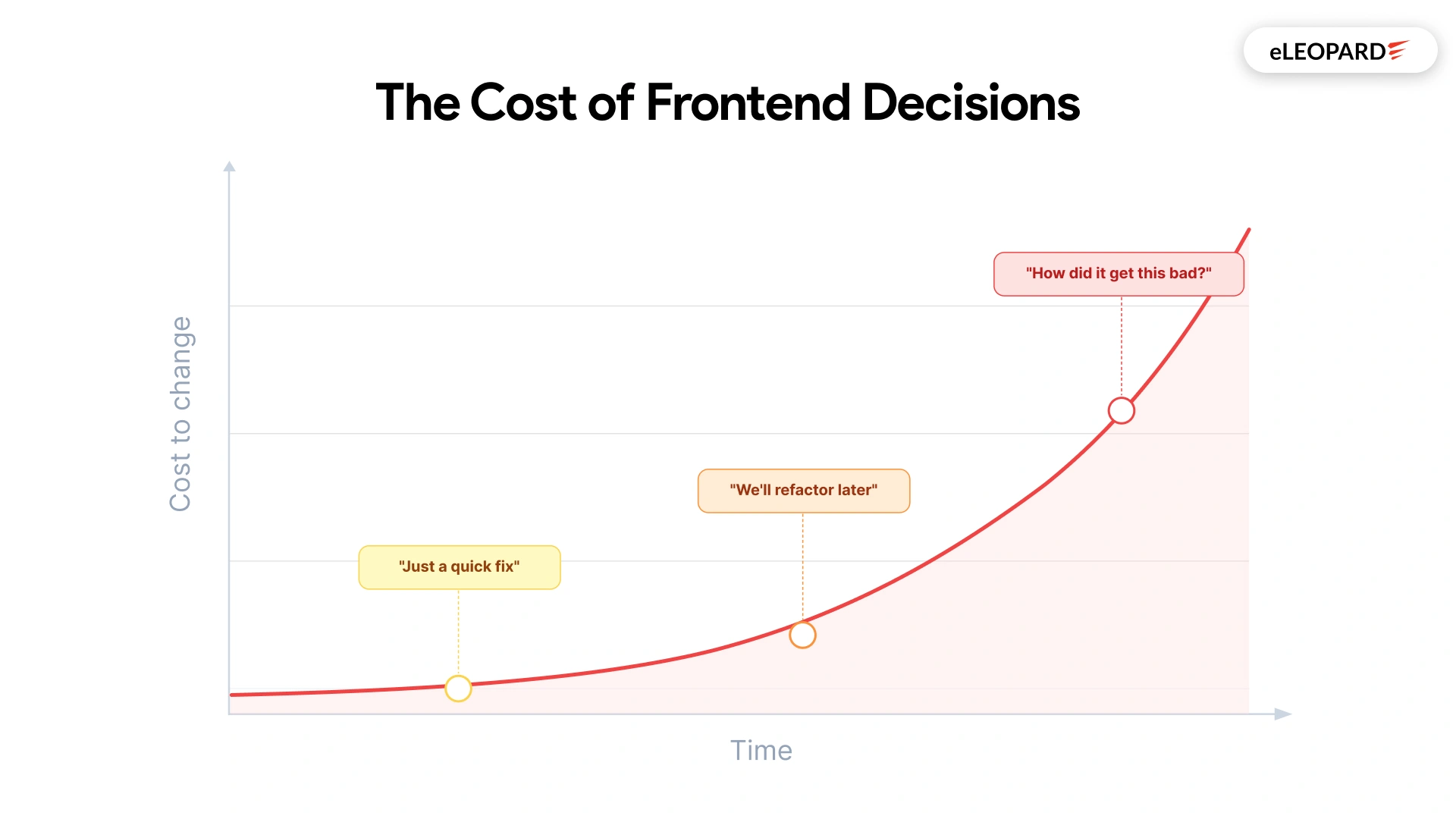
These issues rarely appear suddenly.
They build gradually — through small, seemingly harmless decisions that compound over time.

This article highlights some of the most common frontend anti-patterns observed in real-world systems, and more importantly, how they impact engineering productivity, scalability, and long-term cost.

1. Hidden Performance Costs in the UI Layer

In many applications, unnecessary computations happen during UI rendering.

At a small scale, this goes unnoticed. But as the application grows, it leads to:

  • Slower UI responsiveness
  • Increased rendering cycles
  • Higher browser and system load

Why it matters: At scale, inefficient rendering directly impacts user experience and can increase infrastructure and performance costs.

2. Business Logic Living in the UI

When business rules reside in the UI layer rather than in structured logic layers, systems become harder to manage.

This typically results in:

  • Duplicated logic across multiple components
  • Inconsistent behavior across the application
  • Increased effort to update or extend features
Why it matters: Scattered logic increases maintenance overhead and slows down feature delivery.

3. Poor Resource and Lifecycle Management

Improper handling of reactive flows and system resources often introduces subtle issues over time.

These usually appear as: 

  • Memory leaks
  • Performance degradation in long-running sessions
  • Hard-to-debug production issues
Why it matters: These issues accumulate silently and eventually impact system stability and reliability.

4. Overloaded Components

When a single unit handles too many responsibilities — UI, state, and data — complexity increases rapidly.

Common signs include:

  • Large and difficult-to-understand files
  • Slower development and testing
  • Higher risk of regressions
Why it matters: Poor separation of concerns reduces engineering efficiency and increases long-term maintenance costs.

5. Tight Coupling Across Components

Highly dependent components reduce flexibility in the system.

Over time, this leads to:

  • Difficult refactoring
  • Limited reusability
  • Increased coordination effort across teams
Why it matters: Tightly coupled systems slow down innovation and make changes more expensive.

6. Uncontrolled Data and Event Flows

When data flow is not clearly structured, systems become unpredictable.

This often causes:

  • Unexpected side effects
  • Increased debugging time
  • Hidden dependencies between features
Why it matters: Uncontrolled flows increase cognitive load for developers and reduce overall productivity.

7. Inefficient Rendering in Data-Heavy Screens

Applications that handle large lists or datasets often suffer from unnecessary UI updates.

This results in:

  • Laggy interfaces
  • Poor user experience
  • Increased browser workload
Why it matters: Performance issues at the UI level directly affect user satisfaction and engagement.

8. Ignoring Scalable Rendering Strategies

Default behaviors are often used without considering scale.

In larger systems, this leads to:

  • Unnecessary processing
  • Reduced rendering efficiency
Why it matters: Optimized rendering strategies are critical for building scalable frontend systems.

9. Weak Module and Dependency Structure

When boundaries between features are not clearly defined, systems become fragile.

Typical outcomes include:

  • Hidden dependencies
  • Unexpected breakages
  • Difficult code navigation
Why it matters:  Poor structure slows down teams and increases the risk of production issues.

10. Over-Engineering Too Early

Designing systems for hypothetical future requirements often introduces unnecessary complexity.

This leads to:

  • Slower development cycles
  • Harder onboarding for new developers
  • Increased maintenance overhead
Why it matters: Simplicity enables speed. Over-engineering delays delivery and adds long-term cost.

Conclusion

Frontend systems do not become complex overnight.
They become complex when small, short-term decisions accumulate without structure or long-term thinking.

Teams that actively avoid these patterns benefit from:

  • Faster development cycles
  • Better code maintainability
  • Improved scalability
  • Stronger engineering culture

Final Thought

The biggest risks in frontend architecture are rarely visible in the beginning.
They grow gradually through quick fixes, shortcuts, and lack of clear boundaries — until they start impacting delivery speed, system stability, and business outcomes.

Addressing these patterns early is not just a technical improvement.
It is a strategic advantage for any growing product and engineering team.

Frequently Asked Questions

How do frontend decisions influence business profitability?
Efficient frontend systems lower maintenance expenses, improve developer productivity, and enhance digital customer experiences. These improvements can increase conversion rates, customer retention, and overall revenue performance.
Can frontend modernization reduce technology costs?
Yes. Modern frontend practices reduce technical debt, minimize repetitive engineering work, and improve platform performance. This helps organizations optimize infrastructure usage and reduce long-term development costs.
How do frontend decisions affect product launch timelines?
Poor frontend planning often delays feature releases due to code complexity and maintenance issues. A well-structured frontend enables faster development cycles, smoother collaboration, and more predictable product delivery timelines.
What business risks are associated with outdated frontend systems?
Outdated frontend systems can lead to slower applications, security vulnerabilities, poor mobile experiences, and rising maintenance costs. These issues negatively impact customer satisfaction and limit business agility.
How does frontend performance impact SEO and digital visibility?
Search engines prioritize fast and user-friendly websites. Optimized frontend performance improves search rankings, organic traffic, and discoverability, which supports broader marketing and growth objectives.
Ready to turn your vision into a reality?
Schedule a consultation today and embark on a transformative journey towards technological excellence!