Over the past few years, global EdTech platforms haven’t just evolved, they’ve fundamentally changed how learning works. What used to be static course catalogs are now dynamic systems that adapt in real time.
AI plays a big role here. It quietly powers recommendation engines that suggest what learners should take next, automates assessments so educators don’t have to review everything manually, and even enables chat-based tutors that mimic real conversations.
On paper, this all sounds ideal: better engagement, improved retention, and scalable learning outcomes. But in practice, there’s still a gap between what AI promises and what most platforms actually deliver.
However, while AI adoption is clearly picking up pace, the depth of implementation is all over the place. Many platforms are quick to showcase AI as a feature, something visible in demos or marketing, but far fewer have actually built it into the core of how their product thinks, adapts, and makes decisions.
That difference matters. There’s a big gap between using AI and being truly AI-driven, and that’s exactly where both the opportunity and the complexity sit.
For leaders, this isn’t really about experimenting with one more AI feature anymore. It’s about stepping back and rethinking product strategy, underlying infrastructure, and what actually sets your platform apart. Those who treat AI as a foundational capability will reshape user experience and outcomes in meaningful ways. The rest may find themselves playing catch-up sooner than expected.
In this article, we’ll look at how global EdTech platforms are using AI today, where it’s genuinely creating value, and where things are still falling short. More importantly, we’ll unpack what’s missing if AI is truly going to transform digital learning, not just enhance it on the surface.
So before diving in, it’s worth pausing for a quick reality check: what AI promises, and what’s actually happening on the ground.
What AI Promises vs What Actually Happens
| Expectation | What’s Actually Delivered | Why It Falls Short |
|---|---|---|
Hyper-personalized learning journeys | Basic course recommendations | Shallow data models, limited behavioral inputs |
AI-driven student success | Marginal improvement in completion rates | Lack of real-time intervention systems |
Fully automated operations | Partial automation with human dependency | Fragmented workflows and legacy systems |
Deep learner insights | Surface-level analytics dashboards | Data exists, but isn’t deeply analyzed or activated |
Scalable AI tutors | Scripted or generic chatbot interactions | Weak contextual memory and domain depth |
Where AI Is Actually Being Used Today
AI in EdTech often gets talked about in big, futuristic terms. But if you look closely, the real impact today is coming from a handful of very practical use case areas where AI is already shaping how platforms operate and scale.
1. Personalized Learning Paths
Personalization is probably the most visible and most mature use of AI in EdTech right now.
Instead of pushing every learner through the same linear journey, platforms are starting to adapt in real time. They look at how users interact, where they struggle, what they skip, and adjust the path accordingly.
The interesting part is how dynamic this has become. It’s no longer just “recommended courses.” The system can nudge learners to revisit a concept, skip something they’ve already mastered, or even switch formats entirely, say from video to practice, based on what improves retention.
2. AI-Powered Tutors and Assistants
Conversational AI has introduced a new layer of interactivity in digital learning. Earlier, if you got stuck, you either waited for support or dropped off. Now, learners can ask questions, get explanations, and move forward instantly.
What makes newer systems different is that they’re not just scripted bots. They can understand context, adjust how they explain something, and respond based on the learner’s level. It’s not perfect, but it’s far more useful than static help sections ever were.
3. Automated Assessments and Feedback
Evaluation used to be one of the biggest bottlenecks in scaling education.
AI is starting to remove that friction. Platforms can now assess quizzes, assignments, and even more open-ended responses faster and in many cases, with reasonable accuracy.
But the bigger shift is in feedback. Instead of just showing what’s wrong, systems are beginning to explain why, and that shortens the learning loop significantly.
4. Predictive Analytics for Learner Outcomes
One of the more under-discussed uses of AI is prediction.
Platforms can now spot patterns like when a learner is about to drop off or disengage based on behavior signals such as activity frequency, time spent, or declining performance.
The value here is in acting early. Whether it’s a reminder, a content tweak, or even human intervention, the goal is to fix the problem before it becomes one.
5. Content Generation and Optimization
With generative AI, content creation is speeding up dramatically.
Teams are using AI to create quizzes, summaries, and practice material at scale. In some cases, even full modules are being generated and then refined.
At the same time, AI helps identify what content actually works based on engagement and outcomes, so platforms can continuously improve instead of guessing.
6. Operational Automation
Not all impact is visible to the learner.
A lot of AI value sits in the backend, automating support, improving reporting, and helping teams make faster decisions. It’s not flashy, but it’s critical for scaling without constantly increasing cost or team size.
How Leading Platforms Are Leveraging AI
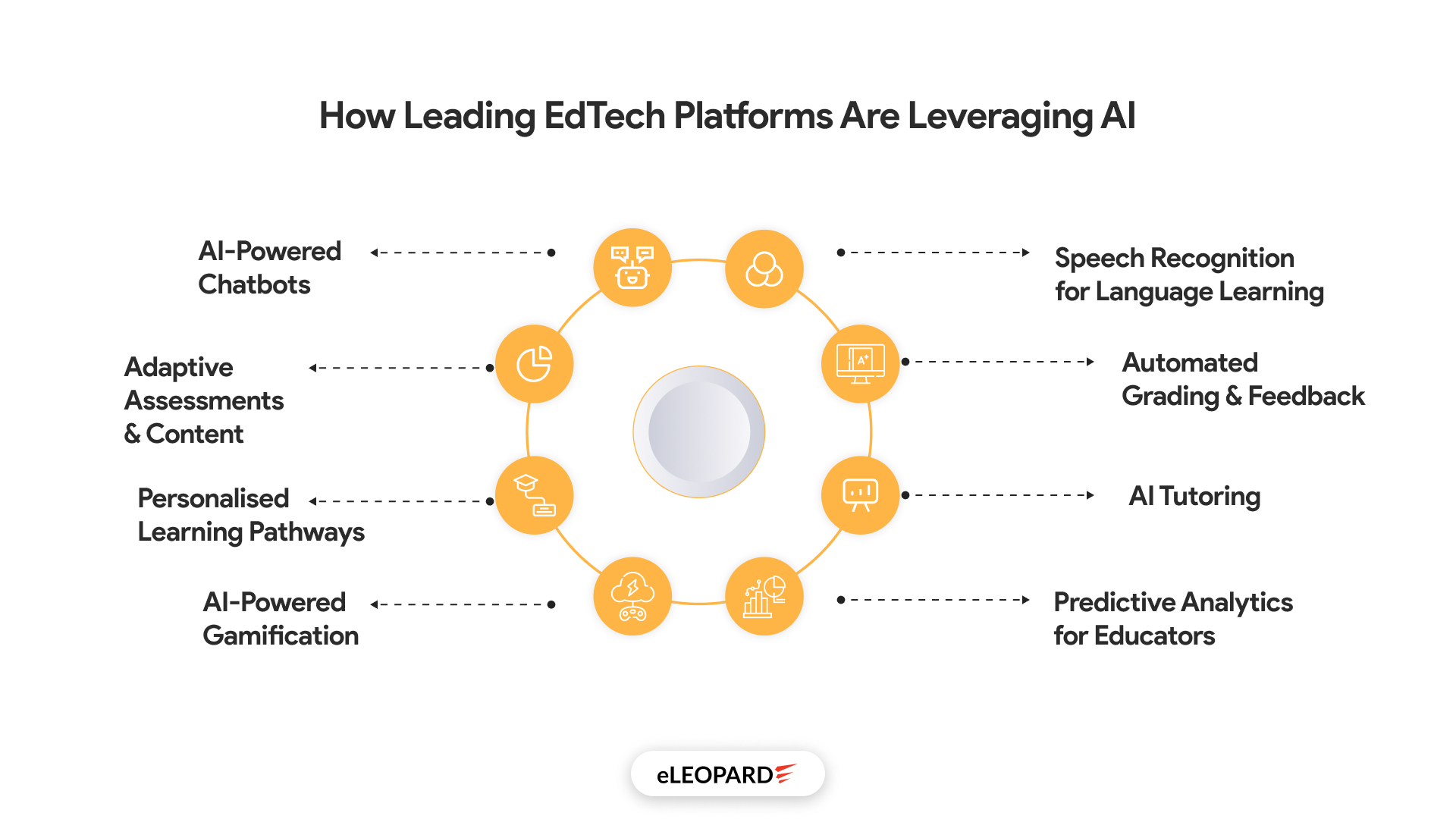
There’s a clear difference between platforms that use AI and those that actually win with it.
Leading EdTech platforms are not treating AI as a set of isolated features; they are building interconnected, intelligent ecosystems where AI drives product decisions, user experience, and business outcomes simultaneously.
1. AI as a Core Product Layer, Not a Feature
Top platforms integrate AI at the architectural level. Instead of adding AI-powered tools on top of existing workflows, they design their systems so that intelligence is baked into every interaction, from onboarding to course completion.
This means personalization engines, recommendation systems, and analytics models are not separate modules but part of a unified data and decision layer that continuously improves the platform experience.
2. Strong Data Foundations
None of this works without data, and not just collecting it, but actually structuring and using it well.
Leading platforms track everything: clicks, pauses, retries, drop-offs. That data feeds back into their models, creating a loop where the system keeps learning from user behavior.
Over time, this becomes a real advantage; it’s hard to replicate.
3. Real-Time Adaptation
More advanced platforms are moving away from fixed rules.
For example, if a learner struggles with a concept, the platform can instantly introduce alternative explanations, additional practice, or AI-assisted guidance, without waiting for predefined triggers or manual updates.
That responsiveness is what makes the experience feel intelligent.
4. Human + AI, Not Human vs AI
The best implementations aren’t fully automated; they’re balanced.
AI can generate, suggest, and optimize. But human experts still play a critical role in validating, refining, and aligning content with real learning goals.
This combination is what keeps quality high while still allowing scale.
5. Outcome-Focused AI, Not Just Engagement Metrics
A lot of platforms still optimize for surface-level metrics, clicks, time spent, and session length.
More mature players are shifting focus to actual outcomes:
- Are learners completing courses?
- Are they building skills?
- Is there a real-world application?
That shift requires better modeling, but it’s also where real differentiation starts to show.
6. Cross-Functional AI Integration
AI is no longer confined to product teams. Leading platforms integrate AI across functions, marketing, sales, customer success, and operations.
- Marketing teams use AI for segmentation and personalized outreach
- Sales teams leverage predictive insights for lead qualification
- Support teams deploy AI to resolve queries faster and at scale
This creates a cohesive, data-driven organization where every function benefits from shared intelligence.
In many ways, what we’re seeing now is a shift from simply adopting AI to actually orchestrating it.
The systems are getting smarter. The experiences are getting more adaptive. But even with all this progress, there are still gaps, some fairly fundamental that limit how far AI can really go in transforming learning.
And that’s where the next phase begins.
Core AI Technologies Powering EdTech
Behind every AI-powered learning experience is a stack of technologies working together to interpret data, generate insights, and automate decisions. The most impactful EdTech platforms are built on a combination of the following core capabilities:
Natural Language Processing (NLP)
Enables conversational interfaces, AI tutors, automated feedback, and content understanding. NLP allows systems to interpret learner queries, generate explanations, and interact in a human-like manner.
Machine Learning (ML)
Drives personalization, recommendation engines, and predictive analytics. ML models continuously learn from user behavior to refine learning paths and improve engagement outcomes.
Generative AI
Accelerates content creation, quizzes, summaries, simulations, and even full modules. It also enables dynamic explanations according to individual learners.
Computer Vision
Used in proctoring, engagement tracking, and behavioral analysis. While powerful, it also introduces privacy and ethical considerations that require careful handling.
Knowledge Graphs & Semantic Systems
Help structure content and map relationships between concepts, enabling deeper personalization and more intelligent navigation across learning materials.
Together, these technologies form the intelligence layer that powers modern EdTech platforms, but their effectiveness depends heavily on how they are integrated.
Architecture of AI-Driven EdTech Platforms (A Systems-First View)
Most discussions around AI in EdTech focus on features, recommendations, chatbots, and dashboards. But at scale, competitive advantage comes from how the system is designed, not what it superficially offers. High-performing platforms treat architecture as a living system where data, models, and user interactions are continuously synchronized.
A simple way to understand it:
Step 1: Understand the Learner
The platform tracks what users learn, where they struggle, and how they behave.
Step 2: Make Smart Decisions
AI uses this data to decide what the learner should see next.
Step 3: Deliver Personalized Experience
Content, difficulty, and support adjust automatically for each user.
Step 4: Learn from Outcomes
The system improves based on results—what worked and what didn’t.
In short:
Observe → Decide → Personalize → Improve
The most successful platforms ensure these layers are not siloed but continuously connected, creating a feedback loop that drives constant improvement.
What’s Missing in the AI Stack
Despite rapid adoption, most EdTech platforms still have critical gaps in their AI stack:
Lack of High-Quality, Structured Data
Many systems collect data, but it is fragmented, inconsistent, or not optimized for machine learning. Without clean data, even the most advanced models underperform.
Disconnected Systems
AI features often exist in isolation—recommendation engines, chatbots, analytics tools, without a unified intelligence layer.
Weak Feedback Loops
Platforms fail to close the loop between outcomes and system learning. AI models are not consistently retrained based on real-world results.
Limited Focus on Learning Outcomes
Too much emphasis on engagement metrics, not enough on actual skill development or knowledge retention.
Ethical and Compliance Gaps
Issues around bias, transparency, and data privacy are often reactive rather than proactively addressed.
These gaps prevent AI from reaching its full potential as a transformative force in education.
Strategic Takeaways for Tech Leaders
For leaders navigating AI adoption in EdTech, the focus should shift from experimentation to execution:
- Think Systems, Not Features : AI should be embedded across the platform, not added as isolated capabilities.
- Invest in Data First : Data quality, structure, and accessibility are foundational to any AI success.
- Align AI with Outcomes : Measure success based on learning impact, not just engagement metrics.
- Build Continuous Learning Loops : Ensure models evolve with user behavior and real-world results.
- Adopt a Hybrid Approach : Combine AI efficiency with human expertise to maintain quality and trust.
What the Industry Needs to Fix Now
To unlock the next phase of growth, the EdTech industry must address systemic challenges:
Standardization of Data and Systems
Lack of interoperability limits scalability. Common standards are needed to enable seamless integration across platforms.
Stronger AI Governance
Clear frameworks for transparency, fairness, and accountability must be established—not as compliance checkboxes, but as core design principles.
Deeper Integration of AI into Learning Design
AI should not just optimize delivery; it should shape how learning experiences are designed from the ground up.
Bridging the Talent Gap
There is a shortage of professionals who understand both education and AI. This gap slows meaningful innovation.
From Hype to Measurable Impact
The industry must move beyond showcasing AI capabilities to proving real, measurable learning outcomes.
In Wrap
AI has already begun reshaping EdTech, but the transformation is far from complete. While many platforms have adopted AI in some form, only a few have fully integrated it into the core of their systems, strategies, and learning models.
The next phase will not be defined by who uses AI, but by who uses it well—with strong data foundations, integrated architectures, and a clear focus on outcomes. Platforms that get this right will not just scale faster; they will redefine what effective digital learning looks like.
Looking for AI Solutions for Your EdTech Platform?
If you’re exploring how to integrate AI into your platform or scale your existing capabilities. This is where the real opportunity lies.
From building intelligent learning systems and personalization engines to designing scalable AI architectures, the right approach can significantly impact engagement, efficiency, and outcomes.
Looking for AI solutions for your EdTech platform? We can help. Let’s turn your platform into an intelligent, future-ready learning ecosystem. Contact our team today!
