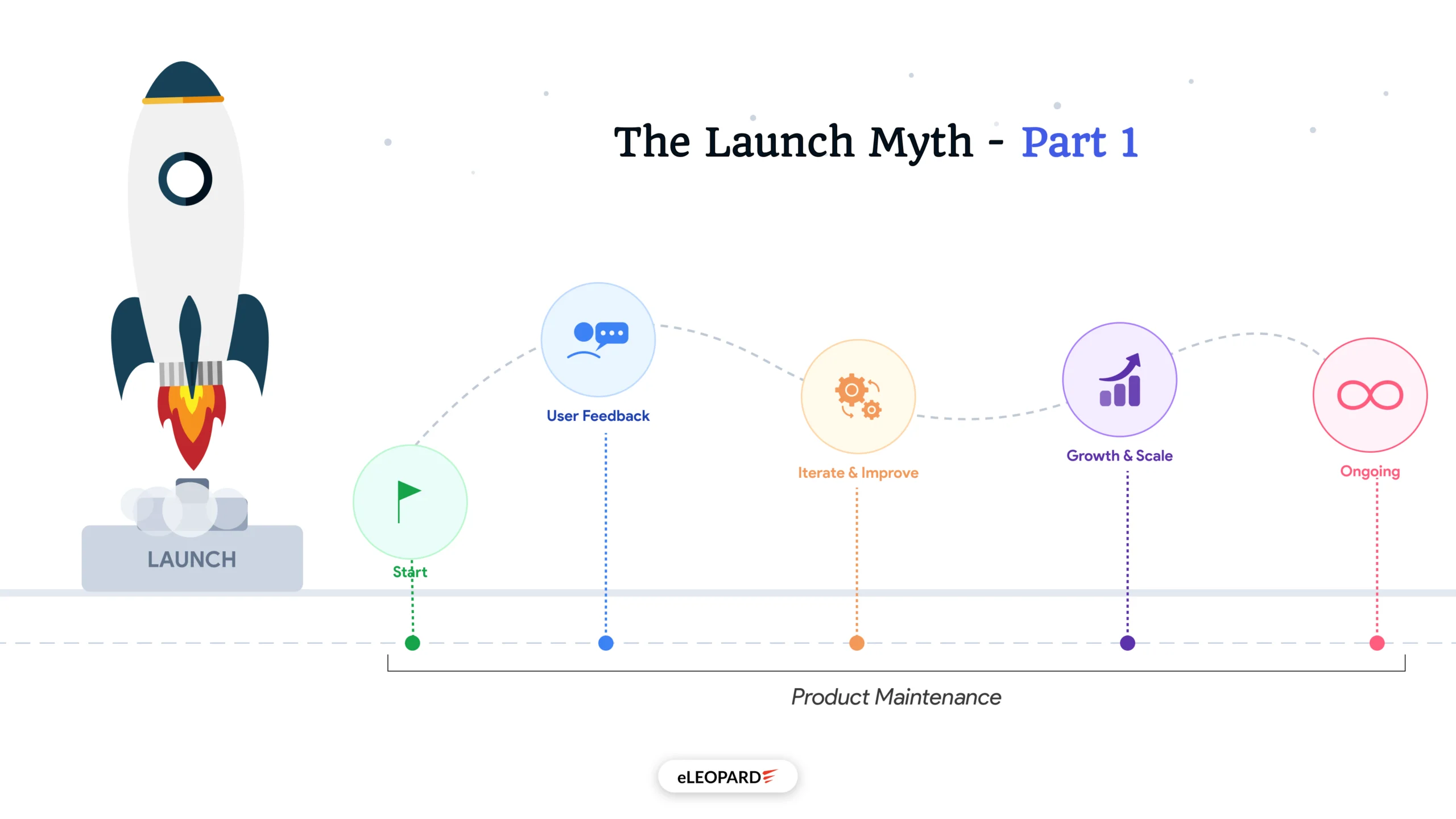
The Launch Myth: Why Shipping Is the Beginning, Not the End (Part 1 of 6)
There is a moment every product team knows intimately. The sprint is done. The staging environment is clean. The last pull request has been merged. Someone drops a link in the team chat, and for a few seconds, everyone just stares at the screen together.
Then someone types: “We did it.”
And they did. Launching a digital product is genuinely hard. It takes months of difficult decisions, painful trade-offs, late nights debugging things that shouldn’t be broken, and an almost irrational belief that what you’re building is worth building. The launch moment deserves to be celebrated.
The problem is what happens next.
The myth that's costing companies millions
Somewhere along the way, the industry developed a strange relationship with launch day. It became the destination, the finish line that justified the roadmap, the budget, the org chart, the press release. Investors circled it on calendars. Leadership tied bonuses to it. Marketing planned campaigns around it.
And yet, for the majority of digital products, launch day is the last time things feel like they’re going well.
Only 40% of products developed by companies survive on the market long-term (BusinessDasher, 2024). For software and digital products specifically, the numbers are even more stark. As many as 70 to 90% of new products struggle to gain lasting momentum (Harvard Business Review), not because the idea was wrong, but because the product wasn’t built to do anything beyond launch.
This is the launch myth: the belief that getting a product out the door is the measure of success. It isn’t. It never was. Launch is the moment you earn the right to find out whether your product can actually survive in the real world.
What "successfully launched" really means
When engineering and product teams describe a launch as successful, they usually mean one of a few things:
- It shipped on time (or close enough)
- It didn’t immediately break in production
- Early user metrics looked reasonable
- Senior stakeholders signed off
These are reasonable things to care about. None of them predicts whether your product will still be growing in eighteen months.
The companies that build lasting digital products measure something different. They ask questions that most teams aren’t even thinking about on launch day:
- Can this architecture support ten times the current load?
- How long does it take to ship the next feature — not this one, but the one after that, and the one after that?
- What is the ratio of time spent on new value versus maintaining what already exists?
- If a critical engineer left tomorrow, how long would it take the team to recover?
These aren’t philosophical questions. They are engineering questions, and the answers are already embedded in every architectural decision, every shortcut, and every piece of code that got checked in under pressure during those last few sprints before launch.
Most teams don’t ask them until it’s expensive to answer.
The three phases where products succeed or fail
Understanding why products fail after launch requires understanding the lifecycle they’re actually entering. It isn’t a straight growth curve. It’s a gauntlet — and the obstacles at each stage are different.
Phase One: Initial Traction (months 1–6)
This is the honeymoon period. The product is new, the team is energised, and early users are forgiving. Performance issues are tolerated because the product is interesting. Bugs are accepted because the team is responsive. The architecture decisions made under pre-launch pressure haven’t yet had time to compound.
Many teams mistake the absence of crisis for the presence of health. The product isn’t thriving yet; it’s just too new for its structural problems to be visible.
Phase Two: Growth Pressure (months 6–18)
This is where the first wave of failures happens. User growth starts creating load the original architecture wasn’t designed for. Feature requests from customers reveal that the initial product scope was narrower than the market actually needs. The engineering team, which was lean and fast at launch, is now spending an increasing share of its time on maintenance, patches, and workarounds for earlier decisions.
Velocity drops. Leadership notices. The pressure to ship more features increases. Which leads to more shortcuts. Which leads to more maintenance. The cycle accelerates.
Post-launch failure rates reach approximately 25% in the first year and 40% by the end of the second year, according to a study published in Marketing Letters (2021). Most of those failures don’t happen because the market disappeared. They happen because the product couldn’t evolve fast enough to meet it.
Phase Three: The Scaling Wall (18 months+)
Companies that survive the growth pressure phase often hit a harder wall later: the scaling inflection point. This is the moment when the product’s user base, transaction volume, or geographic footprint outgrows what the original system was designed to handle.
At this stage, the cost of the early decisions becomes fully visible. What was a manageable monolith becomes an unmovable liability. What was a simple database schema becomes a bottleneck. What was an acceptable level of technical debt becomes the reason why every new feature takes three times longer to ship than it should.
The companies that clear this phase aren’t necessarily smarter or better funded. They made different decisions earlier, or they identified their problems early enough to fix them before the wall arrived.
The AI Shortcut Trap
Another challenge emerging in recent years is the belief that AI can replace product strategy, architecture planning, and experienced engineering teams. AI tools can accelerate development, generate code, and improve productivity, but they cannot make critical decisions about scalability, security, user experience, business requirements, or long-term product evolution.
Many companies launch products faster using AI-assisted development and assume the hard work is done. The reality becomes apparent during the growth phase. As user demands increase, integrations become more complex, and performance expectations rise, products often require architectural improvements, technical expertise, and strategic planning that AI alone cannot provide.
The most successful companies use AI as a tool, not as a replacement for experienced product teams. They combine AI-driven efficiency with skilled developers, architects, designers, and product strategists who can build systems designed to grow. In many cases, partnering with an experienced product development company early helps businesses avoid the costly technical debt and scalability issues that emerge later in the product lifecycle.
Why smart teams still get this wrong
If the pattern is this predictable, why do so many capable teams fall into it?
The answer isn’t incompetence. It’s incentives.
Product teams are typically measured on delivery: shipping features, meeting deadlines, hitting launch dates. The metrics that determine whether those decisions were good ones — system reliability under load, long-term engineering velocity, the cost of future changes — appear months or years later, long after the original decisions have been made and the responsible individuals have moved on to the next project.
This creates a systematic bias toward building for now rather than building for what comes next. Architectural shortcuts that save two weeks before launch can cost two months a year later. But the person who made that call in week eight of the project usually isn’t the one dealing with the consequences in month fourteen.
There’s also a more honest explanation: building for scale before you need it is genuinely hard to justify. When a startup is trying to get its first hundred users, spending engineering time on resilience and modularity that won’t be tested for eighteen months feels irresponsible. The instinct to ship, learn, and iterate is correct — but only if the iteration is actually possible. A product built on a fragile foundation doesn’t iterate. It stalls.
What the companies that scale actually do differently
There is a common misconception that the companies known for building durable, scalable products simply had more resources or better engineers. Some did. Most didn’t. What they had was a different understanding of what they were actually building.
They weren’t building a product to launch. They were building a platform to evolve.
The distinction sounds abstract until you see it in practice. It shows up in how architecture decisions get made: not just “does this work?” but “how do we change this when we need to?” It shows up in how engineering teams measure success: not just “did we ship?” but “how fast can we ship the next thing, safely?” It shows up in how technical leadership engages with business strategy: not as a service desk executing feature requests, but as a co-author of the product roadmap.
The most telling indicator of a product’s long-term health isn’t its launch metrics. It’s what happens to engineering velocity six months after launch. Products built on strong foundations get faster as the team learns and optimises. Products built on fragile foundations get slower — reliably, measurably, and expensively.
This series: a framework for building products that last
Over the next five articles, we’re going to examine the specific failure patterns that prevent digital products from scaling, and the decisions that separate the companies that break through from the ones that stall.
We’ll look at the architectural traps that seem like smart shortcuts but compound into liabilities. We’ll examine how technical debt accumulates invisibly until it dominates your engineering roadmap. We’ll explore why engineering and business strategies so often fall out of alignment — and what the consequences are when they do. We’ll walk through the specific inflection points where products hit scaling walls, and what it takes to clear them.
And we’ll articulate what it looks like when a digital product is genuinely built to evolve: the architecture patterns, the team structures, the engineering rituals, and the strategic alignment that lets companies ship faster as their products get more complex, not slower.
Every company in this series has faced the same moment: the launch high fades, the real world arrives, and the product has to prove it can handle what comes next.
The difference between the ones that do and the ones that don’t isn’t luck. It’s preparation — and it starts long before launch day.
Is your product built for what comes after launch?
The questions your engineering team should be able to answer clearly aren’t complicated. How long does it take to ship a new feature end to end? What percentage of engineering time goes toward maintenance versus new development? Where are the single points of failure in your current architecture? What happens to your system if usage doubles next month?
If the answers are uncertain, vague, or uncomfortable, you’re not alone, and it’s not too late. But the gap between where your product is today and where it needs to be doesn’t close by itself.
“At eLEOPARD, we work with engineering teams and product organisations to do the honest architectural assessment most companies avoid until they’re forced into it: mapping the structural risks in your current system, quantifying the real cost of your technical debt, and building a roadmap that gets your product to the place it needs to be.”
If you want to understand where your product actually stands, before the next growth phase exposes it, that conversation starts here.
Next in the series: The Architecture Trap: How Early Shortcuts Become Long-Term Liabilities — the specific decisions made in the first sprint of a product’s life, and the predictable ways they constrain the next eighteen months. Read Part 2.
About this series: Why Most Digital Products Fail After Launch is a six-part series exploring the engineering and strategic decisions that determine whether digital products survive and scale. Each article examines a distinct failure pattern — and what successful companies do differently.
Frequently Asked Questions
Is launching a product the most important stage of product development?
Launch is important, but it is only one milestone in a product’s lifecycle. Long-term success depends on how effectively teams analyze user behavior, address issues, release updates, and adapt the product based on market feedback.
What is the biggest misconception about product launches?
One of the most common misconceptions is that a successful launch guarantees success. In reality, many products experience their greatest challenges after launch, when they must prove their value to real users and compete in the market.
Why is user feedback critical after launch?
User feedback reveals how customers actually interact with a product. It helps teams identify usability issues, uncover unmet needs, validate assumptions, and make informed decisions about future improvements.
How long should product teams continue improving a product after launch?
Product improvement should be an ongoing process. Customer expectations, market conditions, and technologies constantly evolve, making continuous optimization essential for maintaining relevance and competitiveness.
Can a poorly performing product recover after launch?
Yes. Many successful products faced challenges after launch but improved through user feedback, data-driven decisions, and continuous optimization. If your product isn’t meeting expectations, our product consulting and optimization services can help identify bottlenecks, improve user experience, and create a roadmap for sustainable growth.
