This is Article 2 in the series Why Most Digital Products Fail After Launch. If you’re just joining us, start from the beginning: The Launch Myth: Why Shipping Is the Beginning, Not the End (Part 1 of 6)
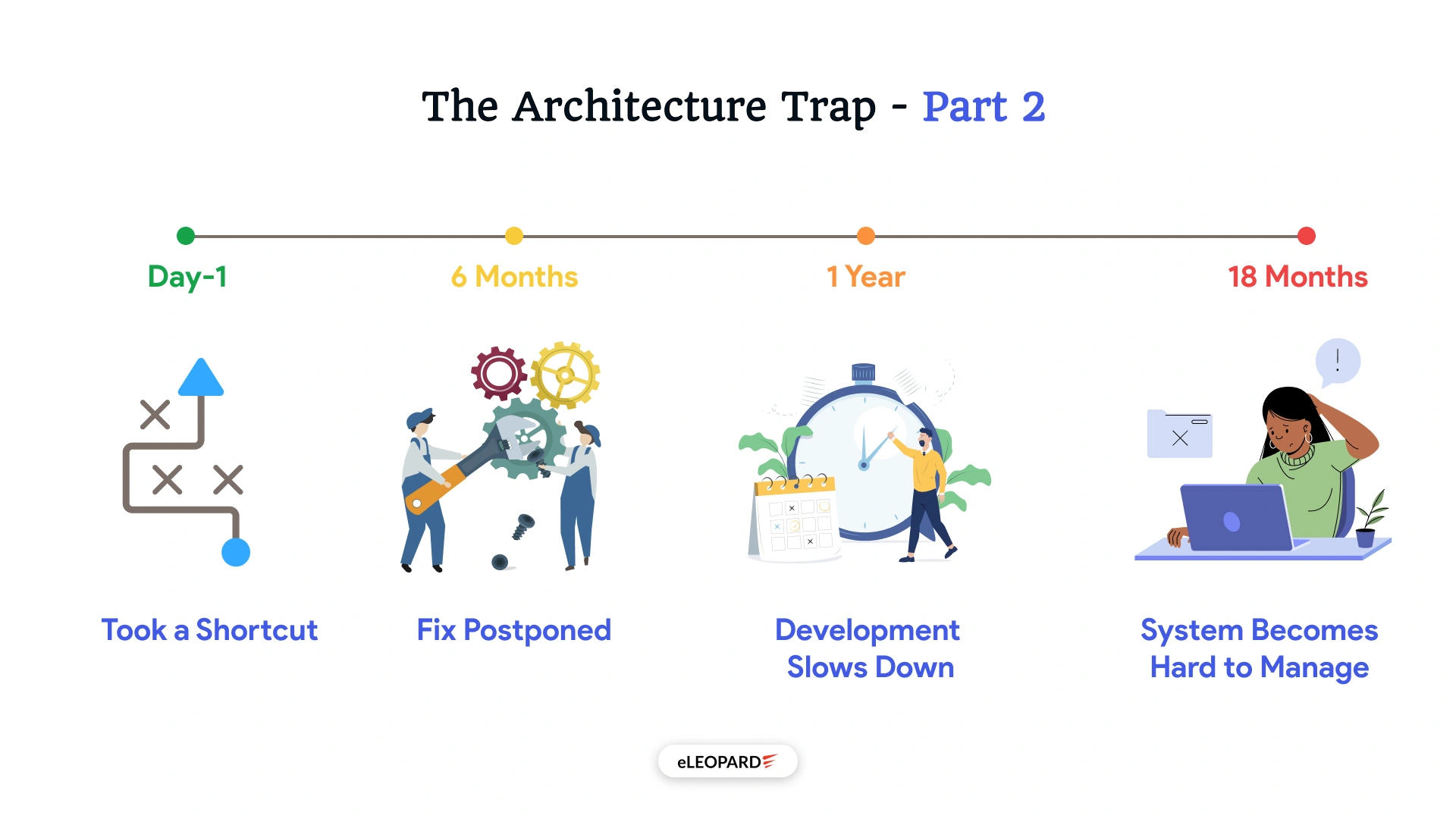
Picture a product team fourteen months after a successful launch. The growth numbers are real. The users are engaged. Leadership is pleased. And somewhere in the middle of a sprint planning meeting, an engineer says something that quietly changes the mood in the room:
“That feature should take a week. It’s going to take six.”
Nobody argues. Because everyone who’s been on the codebase for more than a few months already knows why. Seventeen different parts of the system now touch the database schema that made sense at launch. The shared service that was “temporary” became load-bearing six months ago. The monolith that was supposed to be refactored after the MVP is now too tangled to safely pull apart without stopping everything else.
The feature isn’t hard. The architecture is.
This is the architecture trap, and it doesn’t announce itself until the bill arrives.
The decision that felt perfectly reasonable at the time
Every architecture trap starts the same way: with a reasonable decision made under real constraints.
The team has a deadline. The investors want a demo. The product needs to ship before a competitor does. And so a senior engineer makes a call: use a monolithic structure instead of a modular one, because it’s faster to build. Wire the services together directly instead of through an API layer, because it saves three days. Skip the abstraction that would make the data model extensible, because the current use case doesn’t need it yet.
None of these decisions are reckless. In context, many of them are right. The instinct to ship lean, learn fast, and refactor later is legitimate engineering thinking but only when the “refactor later” part actually happens. In practice, it rarely does. The next sprint arrives with its own pressures. And the next. And the sprint after that. The shortcuts that were meant to be temporary become permanent by default, not by design.
According to a McKinsey survey, technical debt accounts for 20 to 40 percent of the entire value of a company’s technology estate, and organisations spend between 10 and 20 percent of their technology budgets managing it. That isn’t the cost of building the wrong product. That is the ongoing tax on building it in a way that made sense at the time.
Three architecture patterns that look like shortcuts and act like anchors
Not all technical shortcuts are equally costly. Some create minor friction that a good engineer can resolve in an afternoon. Others become structural constraints that shape and limit every decision made for years afterwards.
These three patterns appear consistently at the root of the most expensive architecture problems.
The load-bearing monolith
A monolithic architecture where the entire application lives in a single deployable unit is not inherently a bad choice. For early-stage products, it is often the right one. It’s simpler to build, easier to debug, and faster to iterate on when the product is still finding its shape.
The trap isn’t choosing a monolith. It’s treating the monolith as a permanent decision rather than a starting point. As teams add features, the monolith grows. Modules that should be independent become entangled. A change to the payment logic breaks the notification service. A database migration for one feature requires testing the entire application. What began as a pragmatic choice becomes a constraint on how fast and how safely the team can ship.
The question is never “should we have built a monolith?” The question is “did we build it in a way that allows us to move away from it when we need to?”
The shared database
Allowing multiple services or subsystems to access the same database schema directly is one of the most common architectural shortcuts in early-stage products and one of the costliest to unwind. At low scale, it’s invisible. At growth scale, it creates coupling that makes every data model change a high-risk operation affecting parts of the system that weren’t supposed to be involved.
Database queries in presentation layers prevent scaling beyond 10,000 users. The ceiling isn’t theoretical; teams hit it reliably, and often suddenly.
Tightly coupled services
Services that call each other directly, without contracts or abstraction layers between them, create dependency chains that are easy to build and expensive to change. Adding a new integration means touching existing code. Updating one service requires coordinating changes across three others. The system that was fast to build becomes slow to evolve, because nothing in it can change independently.
A 2024 analysis found that 55% of technical debt stems from architectural issues not code quality, not test coverage, not documentation. Architecture. The decisions made before a single line of product code was written.
How the cost compounds
What makes architectural debt different from ordinary technical debt is the compounding effect. A bug in the code is a linear cost: find it, fix it, move on. An architectural constraint is a multiplier. Every feature built on top of a flawed foundation costs more than the last, because the foundation is carrying more weight.
The cost to address architecture debt at a late stage is typically 10 to 100 times the cost that would have been incurred if addressed earlier. That is not a rounding error. That is the difference between a two-week refactor and a six-month re-platform that consumes the entire engineering team’s capacity while the product stands still.
Organisations with high technical debt spend 40% more on maintenance costs and deliver new features 25 to 50% slower than their competitors (McKinsey Digital, 2024). That velocity gap is not recoverable through hiring. It is only recoverable through structural change.
And yet most teams don’t address architectural debt until the pain is undeniable — because at every stage before that, the short-term cost of addressing it looks higher than the short-term cost of working around it. This is the trap within the trap. The economics of architectural debt are designed to delay action until action is genuinely expensive.
What “good enough for now” looks like eighteen months later
The language of architectural shortcuts is almost always optimistic. “We’ll clean this up after launch.” “This is fine for our current scale.” “We can refactor once we’ve validated the market.” These aren’t lies — at the time, they are genuine plans.
Eighteen months later, that language sounds different. It sounds like:
- “We can’t deploy on Fridays anymore because the risk is too high.”
- “Onboarding a new engineer takes three months because the codebase is too complex to navigate.”
- “We said yes to that enterprise client six months ago and we still can’t deliver the integration they need.”
- “The replatforming project has been in planning for two quarters, and we haven’t started yet.”
According to Gartner, 80% of technical debt will be architectural in nature by 2026. The implication is important: the biggest constraint on most engineering teams’ ability to ship isn’t the quality of their developers. It’s the structure of the system those developers are working inside.
The signs your architecture is already working against you
Architectural problems rarely announce themselves clearly. They surface through symptoms that look like engineering performance issues or team capacity problems — which is why they go misdiagnosed for so long.
These are the patterns that should prompt a serious architectural review:
Velocity is declining despite a growing team
If adding engineers is not meaningfully increasing your output, the constraint is not headcount — it’s the architecture that headcount is building on top of.
Small changes require large coordination
If updating one part of the system requires sign-off from three teams and a testing window that spans two weeks, your services are more coupled than they should be.
Your deployment confidence is low
If the team releases with anxiety rather than confidence — if every deployment feels like a risk event — the architecture lacks the modularity and observability that safe, frequent deployment requires.
Senior engineers are spending more time on maintenance than new development
Recent studies reveal that 23 to 42% of development time is lost managing technical debt (Stripe Developer Report, 2024). If your best engineers are spending most of their time managing the consequences of earlier decisions, the compound cost is already high.
Features are getting harder to scope, not easier
In a well-structured system, features get easier to estimate as the team learns the codebase. In a tightly coupled system, they get harder — because every change has unpredictable ripple effects.
If more than two of these describe your current situation, the architectural constraints are already limiting your product’s trajectory. The question is no longer whether to address them — it’s how to address them without stopping everything else.
What building for change actually looks like
The alternative to the architecture trap is not over-engineering. It is not designing for ten million users before you have ten thousand. It is not spending six months on infrastructure before shipping anything.
It is making architectural decisions that are reversible.
The teams that avoid the architecture trap aren’t necessarily building more complex systems. They’re building systems where the components can be changed independently — where a decision made in month two can be revised in month eight without taking down everything built in between.
In practice, this means a few specific things. It means defining clear boundaries between services before you need them, even if you don’t implement modularity straight away. It means treating your data model as a public contract, not an internal convenience. It means building observability in from the beginning — not as an afterthought — so that when things break under load, you can see exactly where and why.
And it means having a technical leader who asks not just “can we build this?” but “what are we giving up if we build it this way?” That question, asked consistently and honestly, is the difference between an architecture that evolves gracefully and one that becomes a liability.
The review you keep deferring
The most common response to architectural concerns is deferral. There’s always a more urgent priority a feature to ship, a client to close, a deadline to hit. The architectural review gets pushed to next quarter, and then the quarter after that, until the scaling wall arrives and deferral is no longer an option.
The core problem is that architectural debt tends to be more abstract than code-level debt. It is layered into the architecture itself, caused by shortcuts, speed-to-market pressures, and decisions that prioritised convenience during the initial build. That abstraction is exactly what makes it easy to ignore and expensive to fix.
The companies that scale successfully are not the ones that never made architectural shortcuts. They are the ones that identified their constraints early enough to address them before the constraints became the product’s defining characteristic.
The right time to understand your architectural risks is before the next growth phase forces them into the open.
Is your architecture a foundation or a ceiling?
Every engineering team believes their codebase is more manageable than it looks from the outside. Sometimes they are right. Often they are not, not because the team isn’t capable, but because the nature of architectural debt is to hide until the moment it can no longer be ignored.
An honest architectural assessment asks the questions most teams avoid: Where are the coupling points that would make growth painful? What would break first if traffic tripled? How long would it take to extract a core service if the business needed it?
At eLEOPARD, we work alongside engineering teams to map the structural risks in existing products not to find fault, but to give leadership and engineers a clear picture of where the constraints are before the next wave of growth makes them impossible to ignore.
If your product is in the growth phase and you’re starting to feel the friction of early decisions, that conversation starts here →
Next in the series: The Hidden Cost of Technical Debt (And Why Most Boards Never See It) — how technical debt accumulates invisibly, what it actually costs in business terms, and why the people who need to act on it are usually the last to know. Coming soon!
About this series: Why Most Digital Products Fail After Launch is a six-part series exploring the engineering and strategic decisions that determine whether digital products survive and scale. Each article examines a distinct failure pattern — and what successful companies do differently.
