Lately, my feeds have been flooded with the exact same repetitive promise: “AI is about to replace frontend engineers entirely.” The pitch usually shows an LLM taking a clean Figma design and instantly spitting out production-ready code. On the flip side, I see senior developers completely dismissing AI, calling it a glorified autocomplete tool that creates more bugs than it solves.
As a Frontend Lead who deals with enterprise client architectures and scaling teams every day, I can tell you that both sides are looking at this from the wrong angle.
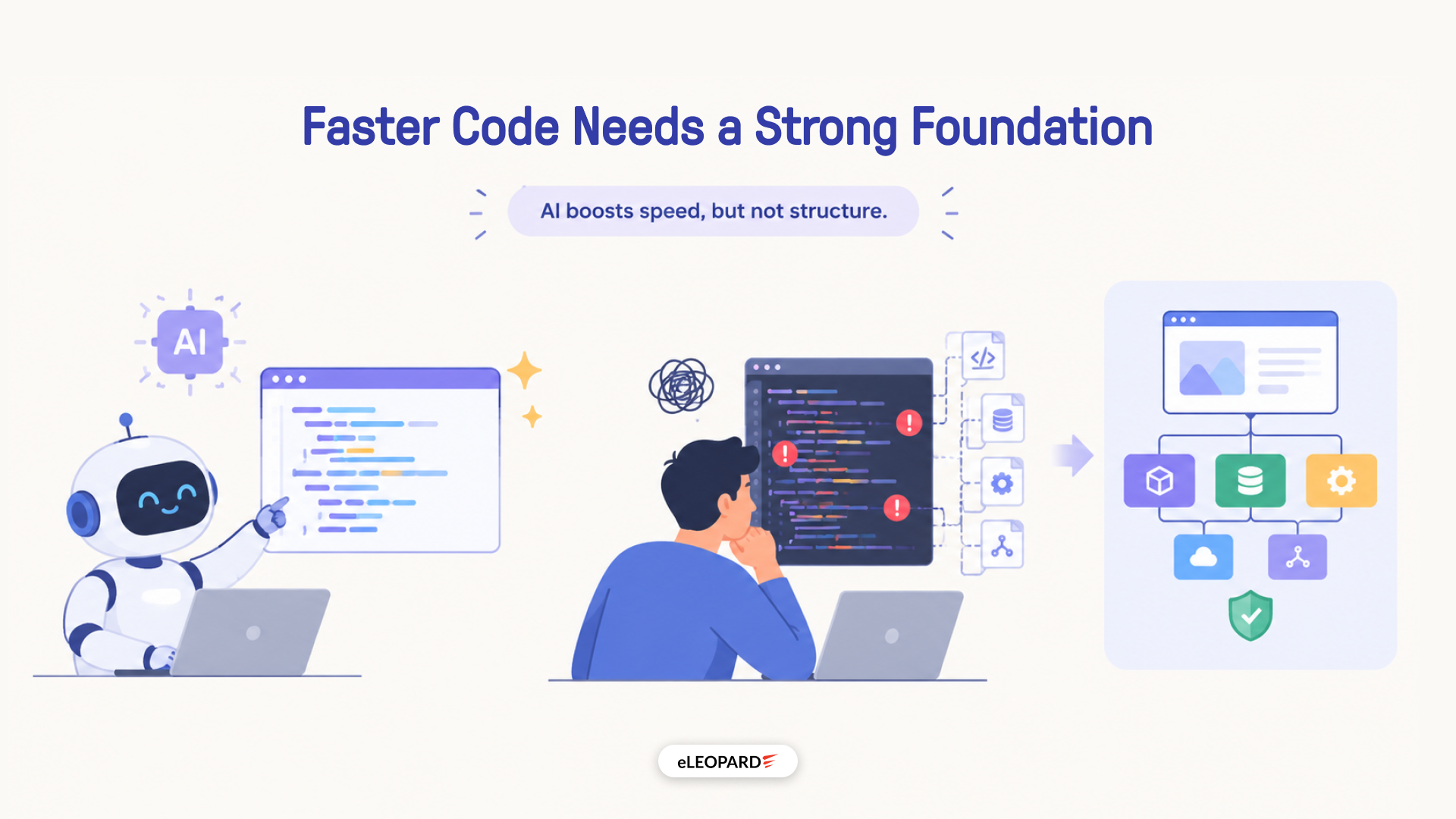
AI isn’t going to replace developers, but it is fundamentally altering the economics of how we build products. However, here is the catch that the marketing demos don’t tell you: AI is a force multiplier, and multipliers only work if your foundation isn’t zero. If your codebase is a mess, AI will simply help your team write messier code at an unprecedented velocity.
Moving Beyond "Component Typing"
When people think of frontend development, they often visualize UI components—buttons, forms, modals, and navbars. This is exactly where GenAI shines. It can scaffold standard HTML, CSS, and basic TypeScript structures in seconds.
But enterprise applications don’t crash because a button component was coded incorrectly. They fail because of what happens under the hood:
- Complex Reactive State: Handling asynchronous data streams and heavy client-side logic without freezing the UI. In modern systems, this means orchestrating reactive architectures—like moving toward Angular Signals—where data updates need to be surgical and efficient.
- Architectural Boundaries: Ensuring that when a team updates a feature in one module, it doesn’t silently break three other workflows across a massive monorepo.
- Performance & Bundle Budgets: Keeping initial load times low through smart lazy-loading strategies and strict change-detection cycles, rather than overloading the browser with bloated dependencies.
AI can write the function inside a file, but it cannot architect the system that prevents your app from lagging when thousands of concurrent users log in.
The Quiet Risk: Exponential Technical Debt
The biggest risk I manage right now isn’t that my team will use AI; it’s that they will trust it blindly.
Because an LLM can output 200 lines of code in a single prompt, the temptation for a developer to simply click “Accept Suggestion” is incredibly high. If they don’t fully comprehend the underlying logic, they are introducing a quiet time bomb into the repository. When a critical production issue hits on a Friday evening, resolving it becomes a nightmare because no human on the team actually authored that code from scratch.
To prevent this from turning our repository into an unmaintainable black box, my role as a Lead has shifted heavily toward strict governance:
- Design System Guardrails: Forcing AI tools to strictly consume and reference our pre-approved, highly accessible (ARIA-compliant) internal UI kits rather than letting them hallucinate custom styles.
- Enforcing Modern API Standards: Keeping our codebase clean by mandating up-to-date framework practices—like standalone components and functional routing—and explicitly blocking the legacy, deprecated syntax that AI models often dig up from old internet data.
- Rigorous Peer Review Pipelines: Upgrading our code review process. We don’t just look for “does it work?” anymore; we actively verify “is this code maintainable and architecturally sound?”
Where the Real Velocity Wins Are
Despite the risks, I don’t block AI in our workflow. Instead, we channel it toward compressing the non-functional, tedious overhead that traditionally eats up our sprint velocity.
What Used to Drain Our Sprints: The AI-Accelerated Reality.
- Boilerplate Testing – Writing repetitive unit test beds and mock assertions used to take hours of manual typing. AI instantly drafts the testing setup, allowing engineers to focus exclusively on covering complex business edge cases.
- API Desynchronization – UI developers sitting idle or writing throwaway code while waiting for backend teams to deploy actual endpoints. AI parses OpenAPI schemas to dynamically generate robust, local mock data objects so we can build out functional UIs immediately.
- Framework Upgrades – Refactoring legacy patterns across hundreds of files during a framework migration used to be a multi-week headache. AI-assisted refactoring automates bulk migrations to modern framework syntax safely, cutting down project timelines significantly.
Engineering is Still About Human Judgment
The goal of integrating AI into modern frontend engineering shouldn’t be to cut corners or reduce engineering headcount. It should be to elevate our execution.
By offloading the repetitive, tactical aspects of coding to AI, we give our engineers the mental bandwidth to focus on what actually moves the needle for our clients: user experience, security, scalable data structures, and product strategy.
When you combine an opinionated, enterprise-grade architecture with AI-accelerated developers, you don’t just ship features faster, you build software that is genuinely built to last.
