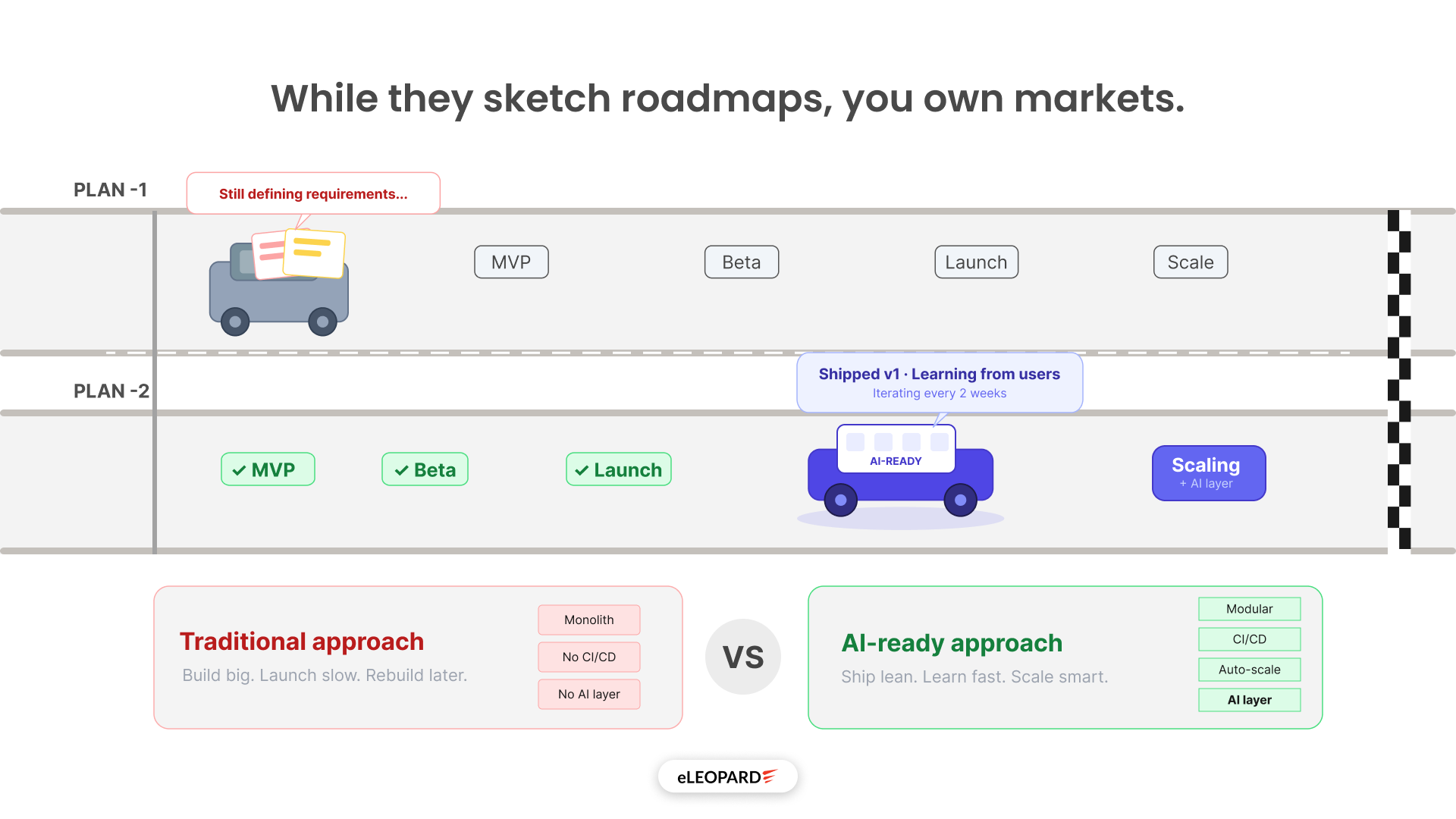
Every month your product stays in development, someone else gets closer to your customers.
The biggest threat to most businesses today isn’t disruption from a tech giant. It’s a faster competitor that launches sooner, learns quicker, and improves relentlessly.
A few years ago, companies won by building more features. Today, they win by shortening the distance between an idea and a customer insight.
The organizations dominating their markets aren’t waiting for perfect roadmaps or flawless product launches. They’re getting real products into real users’ hands, learning from actual behavior, and evolving faster than the competition can react.
In an AI-driven economy, speed is no longer just an operational advantage. It’s becoming one of the most valuable business assets a company can have.
That’s where scalable, AI-ready development becomes a strategic advantage.
The New Competitive Edge Isn't Technology, It's Adaptability
Many organizations still approach software development as a large, one-time project. They spend months defining requirements, building extensive feature sets, and aiming for a perfect launch.
The market rarely rewards that approach anymore.
Customer expectations evolve too quickly. New competitors emerge constantly. AI capabilities advance almost monthly.
The companies gaining market share are launching focused products, learning from users, and improving continuously.
Why AI Readiness Matters Before You Need AI
One of the most expensive mistakes businesses make is treating AI as a future project.
The reality is that AI adoption rarely starts with a massive transformation. It starts with a small use case: a recommendation engine, an automated support workflow, a predictive analytics dashboard, or an intelligent search experience.
Organizations that prepare for those opportunities early can move quickly when business needs arise.
Organizations often discover that their systems weren’t designed to support modern AI capabilities, forcing expensive redevelopment.
An AI-ready application doesn’t mean adding AI everywhere. It means creating the flexibility to add it where it creates value.
What's Actually Slowing Businesses Down?
When leaders talk about delayed software projects, the problem is rarely coding speed.
The real obstacles are usually:
- Overly complex product scope
- Legacy systems that limit flexibility
- Fragmented development processes
- Difficulty finding specialized talent
- Architecture that wasn’t designed to scale
Adding more developers rarely solves these issues. Simplifying decisions, reducing complexity, and building with scalability in mind usually does.
The Fastest Teams Follow a Different Playbook
The most successful digital products share a common pattern.
They start small, validate quickly, and scale intelligently.
Instead of investing heavily in features customers may never use, leading organizations focus on delivering a minimum viable product that solves a real problem. Once market demand is validated, they expand strategically.
Three principles consistently accelerate delivery:
- Agile product strategy to reduce uncertainty
- Modular development to support future growth
- Automation and DevOps to eliminate delivery bottlenecks
This approach doesn’t just speed up development—it reduces risk.
Speed and Quality Are No Longer Opposites
Many business leaders assume faster development means sacrificing quality. Modern software teams prove otherwise.
Reusable components, automated testing, continuous deployment, and mature development frameworks allow organizations to move faster while maintaining reliability.
The key is avoiding unnecessary complexity. The companies that launch quickly aren’t cutting corners. They’re eliminating waste. Every feature, workflow, and technology decision is evaluated through a simple question:
Does this create measurable business value right now? If not, it can wait.
What Makes an Application AI-Ready?
Many businesses are eager to adopt AI, but not every application is prepared to support it. Adding an AI tool to an existing platform does not automatically make it AI-ready. In reality, AI readiness starts with the foundation of the application itself.
An AI-ready application is designed to accommodate intelligent features, process large volumes of data, and adapt as new technologies emerge. It gives businesses the flexibility to introduce AI capabilities without having to rebuild their entire system in the future.
1. A Flexible and Modern Architecture
AI technologies evolve quickly. Applications built on rigid, outdated systems often struggle to integrate new tools, services, or data sources.
A modern architecture allows businesses to add AI-powered features such as chatbots, recommendation engines, predictive analytics, or workflow automation with minimal disruption. Whether the application uses microservices, cloud-native technologies, or API-driven development, flexibility makes future innovation much easier.
2. Strong Data Foundations
AI relies on data to learn, analyze patterns, and generate insights. If data is scattered across multiple systems, poorly organized, or difficult to access, AI initiatives become far more challenging.
AI-ready applications are built with data management in mind. They collect, store, and structure information in a way that supports both operational needs and future AI use cases. Clean, accessible, and reliable data creates the foundation for accurate AI-driven outcomes.
3. Scalable Infrastructure
As AI capabilities are added, applications often require more computing power, storage, and processing resources. An infrastructure that works well for a few hundred users today may struggle when handling thousands of users and AI-powered workloads tomorrow.
Scalable applications are designed to grow without sacrificing performance. Cloud platforms, automated resource allocation, and distributed systems help ensure that the application can support increased demand as the business expands.
4. API-First Connectivity
Modern AI solutions rarely operate in isolation. They often need access to customer data, business systems, third-party services, and external platforms.
Applications that use well-designed APIs can connect with AI services more easily. This enables businesses to integrate new technologies faster, reduce development effort, and create seamless experiences across multiple systems.
5. Security and Compliance Built In
AI systems often process sensitive customer and business information. Without proper security controls, organizations may face privacy risks, compliance issues, and loss of customer trust.
AI-ready applications prioritize security from the beginning. Features such as role-based access controls, data encryption, monitoring, and compliance frameworks help protect valuable information while supporting responsible AI adoption.
6. Real-Time Processing Capabilities
Many AI-powered experiences depend on real-time data. Personalized recommendations, fraud detection, intelligent search, and virtual assistants all require fast access to information.
Applications that can process and deliver data in real time are better positioned to support advanced AI functionality. This allows businesses to provide more responsive and intelligent user experiences.
7. Continuous Improvement and Monitoring
AI is not a one-time implementation. Models, data sources, and user expectations change over time. Applications need the ability to monitor performance, collect feedback, and evolve continuously.
An AI-ready environment includes tools for tracking system health, measuring performance, and supporting ongoing improvements. This ensures that both the application and its AI capabilities remain effective as business needs change.
AI-Ready vs. AI-Enabled: Understanding the Difference
Many organizations focus on becoming AI-enabled by adding individual AI features to existing products. While this can deliver short-term benefits, it does not guarantee long-term success.
An AI-ready application is built with the infrastructure, data strategy, scalability, and flexibility needed to support future AI innovation. Instead of reacting to new opportunities, businesses can confidently adopt emerging technologies as they become available.
In today’s fast-moving digital landscape, AI readiness is not simply about implementing artificial intelligence. It is about creating an application foundation that can support continuous innovation, growth, and competitive advantage for years to come.
AI Features Businesses Should Prepare For Today
Artificial intelligence is no longer limited to experimental projects or future roadmaps. Businesses across industries are already using AI to improve customer experiences, streamline operations, and make faster decisions.
The challenge is not deciding whether to adopt AI, but ensuring your applications are prepared to support the AI capabilities that will drive growth in the years ahead.
By understanding which AI features are becoming essential, businesses can build applications that remain relevant, competitive, and adaptable as technology evolves.
1. Conversational AI and Virtual Assistants
Customers increasingly expect instant support and personalized interactions. AI-powered chatbots and virtual assistants can answer questions, guide users through processes, and provide assistance around the clock.
Unlike traditional chat systems, modern conversational AI can understand context, deliver more natural responses, and handle increasingly complex interactions. Businesses that prepare for conversational AI today can improve customer satisfaction while reducing support workloads.
2. Intelligent Search Experiences
Users want information quickly, regardless of where it is stored. Traditional keyword-based search often falls short when users ask detailed questions or use natural language.
AI-powered search enables users to find relevant information faster by understanding intent rather than simply matching keywords. Whether it’s an eCommerce platform, knowledge base, customer portal, or enterprise application, intelligent search is becoming a standard expectation.
3. Predictive Analytics
Organizations generate vast amounts of data every day. AI can help transform that data into actionable insights by identifying patterns and predicting future outcomes.
Predictive analytics can support a wide range of business goals, including forecasting demand, identifying customer churn risks, optimizing inventory levels, and improving resource planning. Applications designed to support advanced analytics can unlock significant business value over time.
4. Workflow Automation
Many business processes still rely on repetitive manual tasks that consume time and increase the risk of errors.
AI-powered workflow automation can streamline approvals, document processing, customer onboarding, data entry, and countless other operational activities. By automating routine work, businesses can improve efficiency and allow teams to focus on higher-value responsibilities.
5. Personalized Recommendations
Customers increasingly expect experiences tailored to their preferences and behavior. AI recommendation engines analyze user interactions, purchasing habits, and engagement patterns to deliver personalized suggestions.
From recommending products and services to surfacing relevant content, personalization can improve engagement, increase conversions, and strengthen customer relationships.
6. Document Intelligence
Businesses manage large volumes of contracts, invoices, reports, forms, and other documents. Processing this information manually can be slow and resource-intensive.
AI-powered document intelligence can extract data, classify content, summarize information, and identify important insights automatically. This capability is particularly valuable in industries such as finance, legal services, healthcare, insurance, and logistics.
7. Real-Time Decision Support
Modern businesses often need to make decisions in seconds rather than hours. AI can analyze incoming data streams and provide recommendations, alerts, or automated actions in real time.
Whether detecting fraud, monitoring operational performance, managing inventory, or identifying service disruptions, real-time AI capabilities help organizations respond faster and more effectively.
Preparing for Future AI Innovation
While not every business needs all of these capabilities immediately, building applications with future AI integration in mind creates a significant advantage.
Organizations that invest in scalable architecture, strong data foundations, API-driven systems, and cloud infrastructure can adopt new AI features as opportunities arise. Instead of facing costly redevelopment projects, they can integrate emerging technologies faster and with less disruption.
The businesses that succeed in the AI era will not necessarily be the first to adopt every new technology. They will be the ones that build flexible, AI-ready applications capable of evolving as customer expectations and market demands continue to change.
Choosing the Right Technology Stack
When businesses think about launching an application, it’s easy to focus on features and user experience. However, the technology stack chosen behind the scenes can have a significant impact on development speed, scalability, maintenance costs, and future AI adoption.
There is no universal “best” technology stack. The right choice depends on your business goals, growth plans, technical requirements, and long-term vision. Instead of selecting technologies based solely on current trends, organizations should evaluate how each decision supports future scalability and AI readiness.
| Consideration | Why It Matters | Questions to Ask |
| Business Goals | Your technology stack should support your strategic objectives, whether you’re launching an MVP, modernizing operations, or building a digital product. | What outcomes are we trying to achieve over the next 3–5 years? |
| Scalability Requirements | As users, transactions, and data volumes grow, your application should be able to scale without requiring major redevelopment. | Can this stack support future growth and increased demand? |
| AI Integration Potential | AI-powered capabilities often require access to APIs, data pipelines, and cloud services. | Will this stack make it easier to add AI features in the future? |
| Development Speed | Faster development helps businesses reach the market sooner and respond to opportunities more quickly. | Does this technology enable rapid development and deployment? |
| Maintenance and Support | Long-term success depends on keeping applications secure, stable, and easy to update. | Is there a strong developer community and long-term support available? |
| Integration Capabilities | Modern applications need to connect with CRM systems, ERP platforms, payment gateways, analytics tools, and AI services. | Can this stack integrate easily with existing and future systems? |
| Security and Compliance | Security requirements become more important as applications grow and handle sensitive information. | Does this technology support industry security standards and compliance requirements? |
| Cloud Compatibility | Cloud-native applications are often easier to scale, monitor, and optimize. | Is the stack designed to work efficiently in cloud environments? |
Common Technology Stack Components for AI-Ready Applications
| Layer | Common Technologies | Benefits |
| Frontend | React, Angular, Vue.js, Next.js | Fast, responsive user experiences and easier application maintenance. |
| Backend | Node.js, .NET, Java, Python, PHP, Laravel | Supports business logic, integrations, APIs, and scalable application performance. |
| Database | PostgreSQL, MySQL, MongoDB, SQL Server | Reliable data storage and management for operational and AI workloads. |
| Cloud Platform | AWS, Microsoft Azure, Google Cloud | Flexible infrastructure, scalability, security, and access to AI services. |
| API Layer | REST APIs, GraphQL | Simplifies integration between applications, services, and AI tools. |
| AI & Machine Learning Services | OpenAI, Azure AI, Google Vertex AI, Amazon Bedrock | Accelerates AI adoption without building models entirely from scratch. |
| DevOps & Automation | Docker, Kubernetes, GitHub Actions, Azure DevOps | Faster deployments, improved reliability, and simplified scaling. |
The most successful applications are built with the future in mind. A technology stack that works for your current requirements should also provide the flexibility to support new features, AI capabilities, increased user demand, and evolving business goals.
Rather than choosing technologies based solely on popularity, businesses should focus on selecting a stack that aligns with their growth strategy. The right technology decisions today can reduce future development costs, accelerate innovation, and create a stronger foundation for long-term success.
The Businesses That Win Tomorrow Are Building Differently Today
The next generation of market leaders won’t be defined by how much software they build. They’ll be defined by how quickly they can adapt.
Scalable, AI-ready applications provide the foundation for that adaptability. They allow organizations to move faster, respond to change, and adopt new technologies without repeatedly starting from scratch.
The question is no longer whether AI will influence your industry. The question is whether your business will be ready when the opportunity arrives.
eLEOPARD helps organizations launch AI-ready applications that accelerate growth, reduce risk, and create lasting competitive advantage. If you’re ready to move faster and innovate with confidence, now is the time to build the foundation for what’s next.
