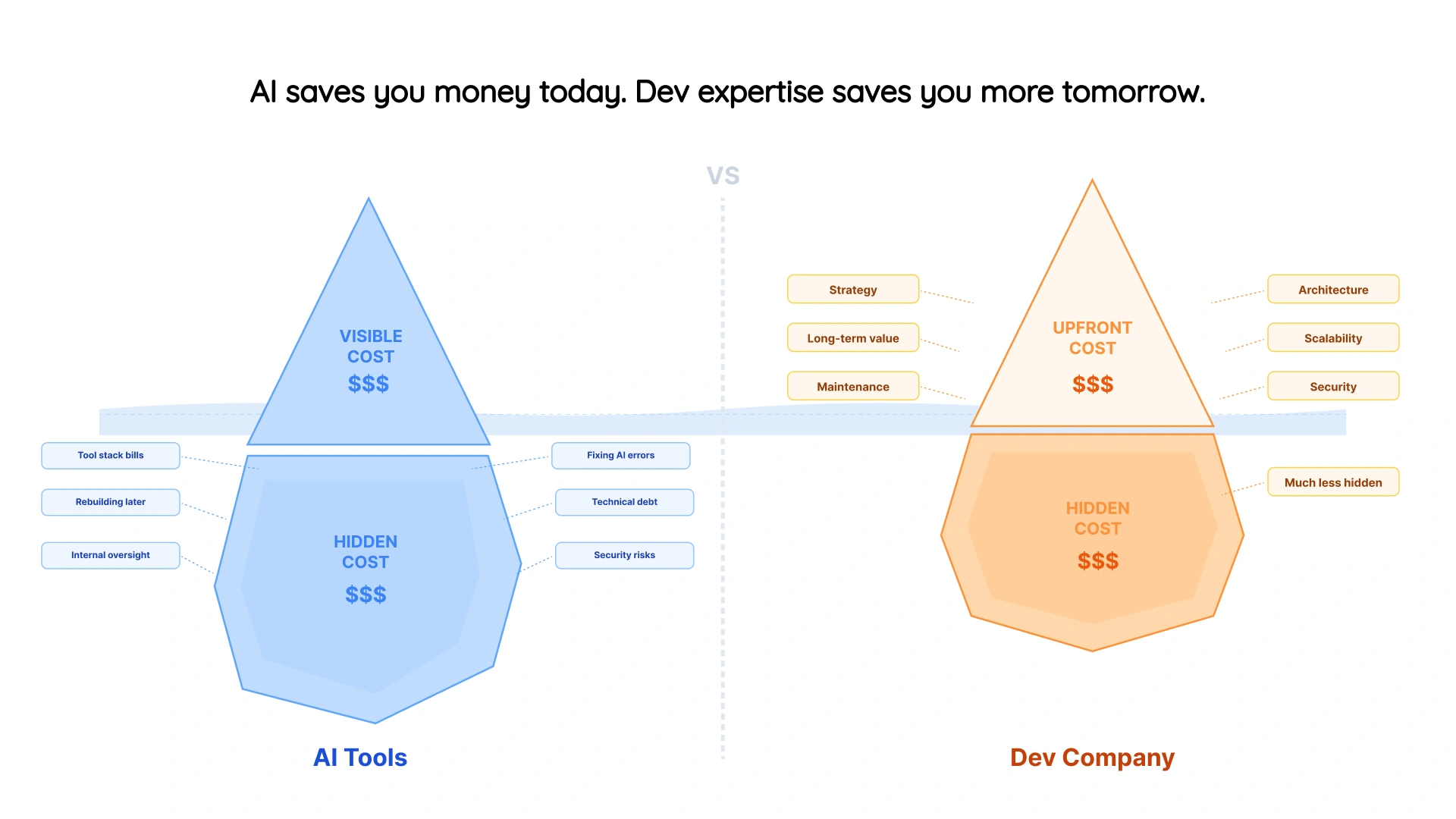
Artificial Intelligence has completely changed the way businesses operate.
Today, companies can generate content, automate workflows, create designs, write code, analyze data, and even build prototypes using AI-powered tools within minutes. Because of this rapid growth, many businesses are now asking an important question:
“Why spend thousands on a development company when AI tools are much cheaper?”
At first glance, AI appears to be the obvious winner.
Most AI platforms cost a small monthly subscription compared to the higher upfront pricing of professional software development services. For startups and growing businesses trying to save money, this sounds incredibly attractive.
But when businesses move beyond experimentation and start building real products, handling customer data, scaling operations, and maintaining long-term systems, the conversation becomes much deeper.
The real comparison is not simply: AI is cheap, and development companies are expensive.
The actual comparison is about:
- Short-term savings
- Long-term costs
- Scalability
- Maintenance
- Execution quality
- Business risk
- Technical stability
- Operational efficiency
And in many situations, the “cheaper” option today can become the more expensive option later.
According to a 2025 global survey by
McKinsey & Company, nearly all surveyed organizations are now using AI in at least one business function. However, only 39% reported a measurable enterprise-level financial impact from AI adoption.
Why Businesses Are Moving Toward AI
AI tools have become extremely accessible.
A few years ago, building software required entire teams, large budgets, and long development cycles. Today, businesses can use AI to:
- Generate website copy
- Create marketing assets
- Write code snippets
- Automate customer support
- Build internal tools
- Create prototypes
- Analyze customer data
- Speed up workflows
For startups and small businesses, this creates a powerful opportunity. Instead of hiring multiple specialists immediately, they can start quickly using AI-powered platforms. This is one of the biggest reasons AI adoption is growing so rapidly across industries.
Businesses want lower operational costs, faster execution, smaller teams, higher productivity, and AI genuinely helps achieve many of these goals. But there’s an important distinction that many businesses overlook:
AI helps accelerate work. It does not automatically guarantee quality, scalability, or business success.
Understanding the Real Cost of AI
Most businesses only calculate the visible cost of AI tools.
For example:
- AI chatbot subscription
- AI coding assistant
- AI content platform
- Automation software
- AI design tool
These subscriptions often seem inexpensive compared to hiring developers or agencies. Most businesses calculate only the visible cost of AI.
For example:
| AI Tool Type | Estimated Monthly Cost |
| AI Writing Tool | $20–$100 |
| AI Coding Assistant | $20–$50 |
| Workflow Automation Platform | $50–$500 |
| AI Design Tool | $10–$100 |
| AI Customer Support Platform | $100–$1000+ |
When compared to development companies, these prices seem very small and for lightweight use cases, AI genuinely can save money. However, businesses often overlook the hidden costs associated with AI adoption that often appear later, after the system begins growing.
Recent industry reports show that AI-assisted development significantly increases development speed, but it can also create new operational challenges.
A 2026 report from
TechRadar found that teams heavily using AI coding tools were deploying code faster, but many also reported higher instability and increased remediation work afterward. This reflects a growing issue in AI-assisted development:
Hidden Costs of Using AI Alone
1. Time Spent Correcting AI Outputs
AI-generated outputs often require significant human review. This is one of the highest overlooked operational costs. AI can generate: code, workflows, content, automation scripts, UI structures, etc., very quickly.
But businesses frequently discover:
- Logic errors
- Broken functionality
- Inconsistent outputs
- Poor optimization
- Repetitive bugs
- Incomplete integrations
As a result, teams spend hours debugging and validating everything. The more complex the project becomes, the more oversight is required.
Example Scenario
A startup may use AI to generate an MVP quickly. Initially, this seems highly cost-effective. But after launching, they may encounter:
- Slow system performance
- unstable databases
- integration failures
- security vulnerabilities
- scaling problems
Fixing these later often costs far more than building correctly from the beginning.
2. Technical Debt Becomes Expensive
Technical debt is one of the most dangerous hidden costs in AI-driven development. Technical debt happens when systems are built rapidly without proper planning or scalable architecture.
At first, everything works. But over time:
- Systems become difficult to maintain
- New features break older functionality
- Updates create instability
- Performance drops
- Development slows down
Eventually, businesses may need complete rebuilding, infrastructure redesign, and codebase restructuring. This is extremely expensive. AI can accelerate development speed but speed without structure often creates long-term operational problems.
3. Security Risks and Compliance Issues
Security is another major area where businesses underestimate costs.
AI-generated systems may unintentionally include insecure code, exposed APIs, and weak authentication systems, but for businesses handling customer data, payment systems, and enterprise operations.
One major security incident can cost far more than the original development investment.
4. AI Subscription Costs Add Up Quickly
Businesses often underestimate cumulative AI expenses. Instead of one tool, companies usually adopt multiple platforms simultaneously.
Typical AI Stack for Businesses
- AI writing assistant
- AI coding tool
- AI automation platform
- AI analytics system
- AI customer support tool
- cloud infrastructure
- third-party APIs
Individually, each tool seems affordable. Combined, the operational cost can become substantial over time.
| Tool Category | Monthly Cost |
| AI Content Platform | $50 |
| AI Coding Assistant | $30 |
| Automation Platform | $200 |
| Cloud Infrastructure | $300 |
| API Usage Fees | $250 |
| AI Support Tool | $400 |
Total Monthly Operational Cost: $1,200+ per month, and this still does not include internal labor costs.
The Human Cost Behind AI
One common myth is that AI removes the need for people. In reality, AI still requires supervision, decision-making, and technical review. Someone inside the company must review outputs, maintain workflows, and fix issues
This internal operational effort becomes part of the total AI cost. AI reduces manual workload. But it does not remove operational responsibility.
Development Companies Are Selling More Than Coding
One of the biggest misconceptions businesses have is that development companies only “write code.” In reality, strong development partners provide:
- Strategic planning
- Technical architecture
- Infrastructure design
- Scalability planning
- Quality assurance
- Product thinking
- Performance optimization
Businesses are not simply paying for hours worked. They are paying for experience and better long-term outcomes. Experienced development teams have already solved hundreds of problems before a business encounters them for the first time. That experience reduces costly mistakes dramatically.
Where AI Performs Best
AI provides exceptional value in several areas.
Best Use Cases for AI
- Repetitive automation
- Internal tools
- Workflow optimization
- Basic prototypes
- Customer support assistance
- Productivity enhancement
- Data summarization
In these situations, AI can reduce operational costs dramatically.
Where Development Companies Deliver Greater ROI
Development companies provide stronger value when businesses require:
- SaaS platforms
- enterprise systems
- customer-facing products
- scalable web applications
- mobile apps
- AI-powered platforms
- secure infrastructure
- custom business ecosystems
These projects involve:
- long-term architecture
- scalability planning
- complex integrations
- advanced security
- continuous maintenance
This is where professional engineering expertise becomes essential.
Comparing AI vs Development Companies
| Factor | AI Tools | Development Company |
| Upfront Cost | Lower | Higher |
| Speed | Very Fast | Moderate |
| Scalability | Limited | High |
| Security | Risk Depends on Usage | Professionally Managed |
| Maintenance | Requires Internal Oversight | Included Support |
| Product Strategy | Limited | Strong |
| Long-Term Stability | Risky for Large Systems | More Reliable |
| Customization | Limited | Fully Custom |
| Technical Debt Risk | Higher | Lower |
| Best For | Small Tasks & Automation | Scalable Digital Products |
The Smartest Businesses Use Both
The future is not AI versus development companies. The most successful businesses are combining both strategically.
Modern development teams now use AI tools internally to accelerate coding, automate repetitive processes, improve efficiency, and reduce delivery timelines. This creates a much stronger balance between speed, quality, scalability, and operational efficiency.
AI becomes a productivity multiplier rather than a complete replacement for engineering expertise.
Final Thoughts
AI is one of the most transformative business technologies of this generation. It is helping companies move faster, reduce repetitive work, improve productivity, and lower operational costs in ways that were impossible only a few years ago.
But businesses should avoid evaluating technology decisions based only on short-term pricing. Because the true cost of software is not just what it costs to launch.
The true cost is maintaining it, scaling it, securing it, improving it, and fixing it later. AI can absolutely reduce development costs. But scalable digital products still require strong architecture, technical planning, security expertise, infrastructure thinking, and long-term engineering decisions.
Build Smarter With AI + Expert Development
AI can speed up workflows, but your products still require strong engineering, strategic planning, and long-term technical thinking, and the right development partner helps you avoid costly technical mistakes while building systems designed for real business growth. Book a free consultation now with us.
Frequently Asked Questions