In 2026, almost every organization is investing in AI to accelerate software delivery, improve quality, and reduce engineering costs. Yet many companies are discovering that simply adopting AI tools doesn’t automatically improve testing outcomes.
The real competitive advantage isn’t the AI platform itself; it’s how effectively your teams communicate with it.
Across engineering organizations, a new capability gap is emerging. It isn’t about choosing the right AI tool. It’s about enabling QA teams to consistently generate accurate, relevant, and high-quality outputs from those tools.
While many businesses have introduced AI for bug analysis, documentation, test case generation, and automation support, few have established a strategy for prompt engineering, the discipline that determines whether AI becomes a productivity multiplier or simply another tool with inconsistent results.
Why QA Teams Are Well Positioned to Lead AI Adoption
Quality assurance teams already possess many of the thinking patterns required to work effectively with AI.
- Identify edge cases
- Question assumptions
- Validate business logic
- Provide detailed scenarios
- Break flows intentionally
- Investigate unexpected behavior
These are the same skills required to create high-quality prompts that produce reliable AI-generated test assets. The difference is that instead of testing software directly, QA professionals are now guiding AI systems to think more like experienced testers.
One of the biggest challenges organizations face is assuming AI will produce enterprise-grade outputs from generic requests.
Teams often enter simple prompts such as:
“Generate login test cases.”
AI will certainly generate something, but not necessarily something aligned with your application’s architecture, business rules, compliance requirements, or quality standards.
The issue is rarely the AI model. It’s the quality of the instructions provided to it.
Why Prompt Quality Directly Impacts Software Quality
Let’s take a simple example.
Basic prompt:
Weak: “Write test cases for the checkout page.”
This usually generates basic positive scenarios that most testers already know.
Now compare that with this:
Strong:“Act as a QA engineer testing an e-commerce checkout flow where one product becomes unavailable during payment. Generate negative and edge case scenarios related to inventory sync, payment failure, session timeout, and cart recovery. Provide output in Gherkin format.”
Now the AI has:
- Clear context
- A role
- A specific problem area
- Edge case focus
- Expected output structure
And suddenly the response becomes far more practical and closer to real testing needs.
This illustrates why prompt engineering should be viewed as an organizational capability rather than an individual productivity trick.
Teams that establish prompt standards consistently produce better AI-assisted documentation, automation scripts, test scenarios, and defect analysis, leading to higher software quality and faster delivery cycles.
Why Prompt Engineering Matters for Engineering Leaders
A lot of companies are introducing AI mainly to save time. And yes, it absolutely helps reduce repetitive work.
Generating initial test scenarios, automation skeletons, SQL queries, API payloads, or regression checklists becomes much faster.
And the bigger advantage is actually consistency. But without proper prompting practices, consistency is impossible to achieve:
Because:
- Every tester gets different quality output with different prompts
- Junior testers struggle with vague prompts
- AI responses become unreliable
- Coverage gaps increase
That’s why QA teams should start building shared prompting standards the same way they build reusable frameworks or testing guidelines.
Without standardized prompting practices:
- Different engineers receive different results
- QA quality becomes inconsistent
- Onboarding junior engineers becomes harder
- Knowledge remains fragmented
- AI adoption delivers unpredictable ROI
This is why leading organizations are beginning to standardize prompt engineering in the same way they standardize coding practices, automation frameworks, and development guidelines.
Organizations should establish shared AI assets such as:
- Prompt libraries
- Reusable prompt templates
- Approved prompt patterns
- AI testing playbooks
- Team-wide AI workflows
These assets become reusable intellectual property that improves productivity across every QA project rather than relying on individual experimentation.
The Mistakes to Avoid
Organizations often make the mistake of treating AI-generated output as production-ready simply because it appears confident.
If AI generates 40 test cases, people assume the work is done.
Without proper review processes, AI can:
- Miss critical edge cases
- Overlook security risks
- Generate duplicate scenarios
- Create unreliable automation code
- Ignore domain-specific requirements
Leading engineering teams treat AI output as a first draft that is validated by experienced professionals before becoming part of the development lifecycle.
Prompt Engineering Expands AI's Value Across the QA Lifecycle
This is one area people don’t talk about enough. AI becomes much more useful during exploratory testing when prompts are written properly.
While exploratory testing is one example, organizations are also applying prompt engineering across:
- Release readiness
- Root cause analysis
- Defect triage
- Automation maintenance
- Security validation
- Requirements analysis
- API testing
The broader the adoption, the greater the return on AI investments.
If the prompt is well written, AI starts exploring the flow from a specific user perspective instead of generating generic observations. That often reveals scenarios teams normally miss.
Small Prompt Improvements Create Better Outputs
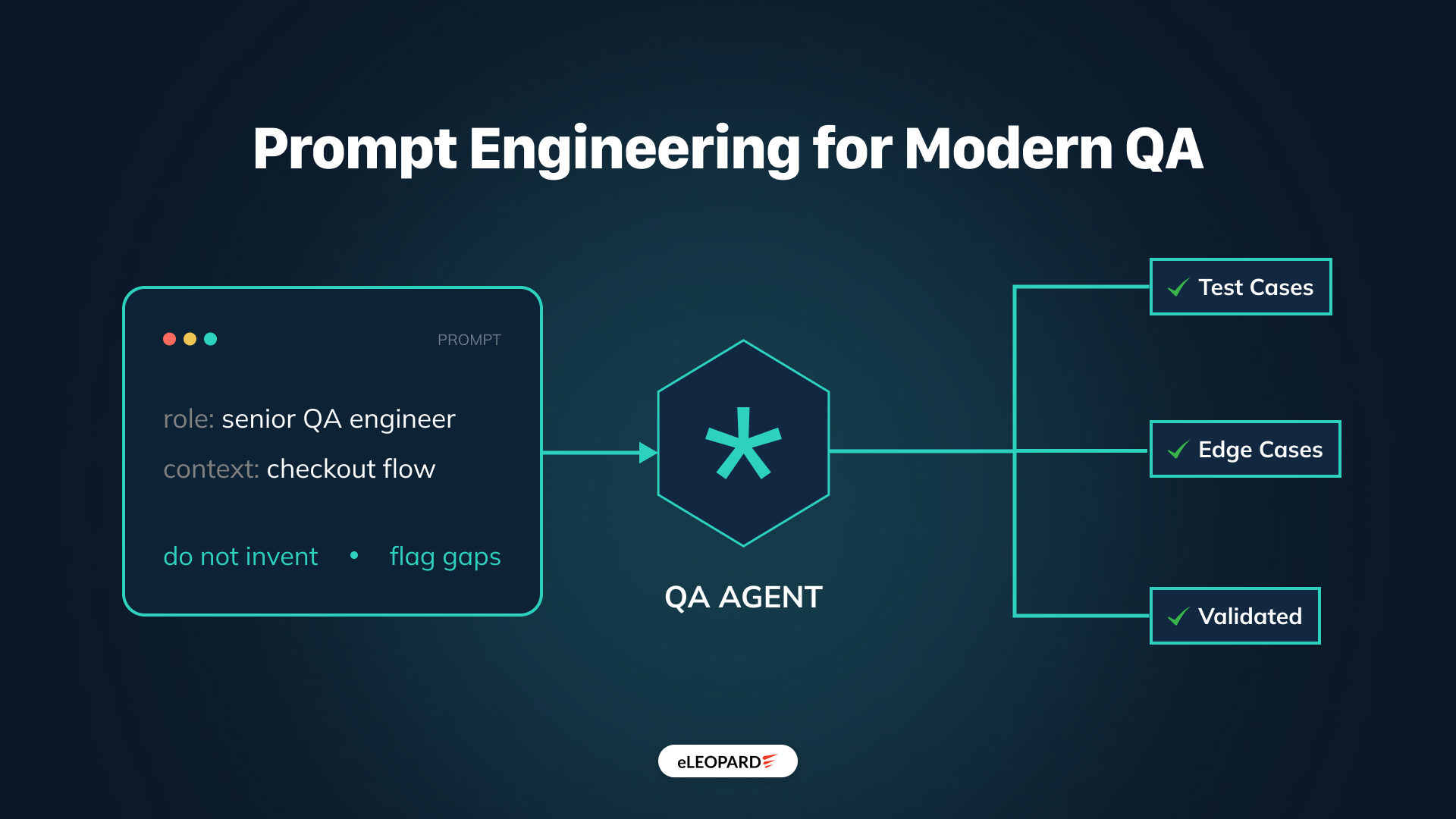
Organizations that successfully scale AI adoption often standardize prompt design around four components:
1. Role
Tell AI who it should behave like.
Example:
“Act as a senior QA engineer.”
2. Context
Explain the product or situation clearly.
Example:
“Testing a banking application with OTP-based login.”
3. Risk or Failure Focus
Highlight what should be validated carefully.
Example:
“Focus on payment interruption and session expiry scenarios.”
4. Output Format
Define how you want the response.
Example:
“Provide results in table format with priority and severity.”
These small additions improve output quality dramatically.
Final Thoughts
AI is rapidly becoming a core part of modern software engineering, but simply purchasing AI tools will not transform software quality.
The real value comes from knowing:
- What to ask
- How to ask it
- How to challenge the output
- How to refine the response until it becomes genuinely useful
Prompt engineering is emerging as one of those foundational capabilities.
By establishing prompt libraries, governance practices, and AI workflows, engineering leaders can improve consistency, accelerate delivery, reduce repetitive work, and increase the value generated from every AI investment.
In 2026, prompt engineering isn’t just a QA skill. It’s becoming a strategic capability for every technology-driven organization.
Frequently Asked Questions
What is prompt engineering in software testing?
Prompt engineering in software testing is the practice of writing structured and context-rich instructions for AI tools to generate accurate test cases, automation scripts, bug analysis, API test scenarios, and other QA artifacts.
Why is prompt engineering important for enterprise AI testing?
Prompt engineering improves the quality and consistency of AI-generated outputs across QA teams. For enterprises, it helps standardize AI-assisted testing, reduce repetitive tasks, accelerate software delivery, and maximize the return on AI investments while maintaining software quality.
How can organizations standardize prompt engineering across QA teams?
Organizations can improve consistency by creating shared prompt libraries, reusable prompt templates, AI testing guidelines, and governance practices. Standardizing prompts helps teams produce reliable outputs, simplifies onboarding, and enables scalable AI adoption across software projects.
Which AI tools are commonly used for prompt engineering in software testing?
QA teams commonly use generative AI tools such as ChatGPT, GitHub Copilot, Gemini, Claude, and Microsoft Copilot to assist with test case generation, automation scripting, documentation, API testing, and defect analysis. The quality of results depends largely on how effectively prompts are designed.
What are the business benefits of prompt engineering for enterprises?
Prompt engineering helps organizations improve testing efficiency, reduce manual effort, enhance software quality, accelerate release cycles, increase consistency across QA teams, and maximize the value of enterprise AI initiatives.
