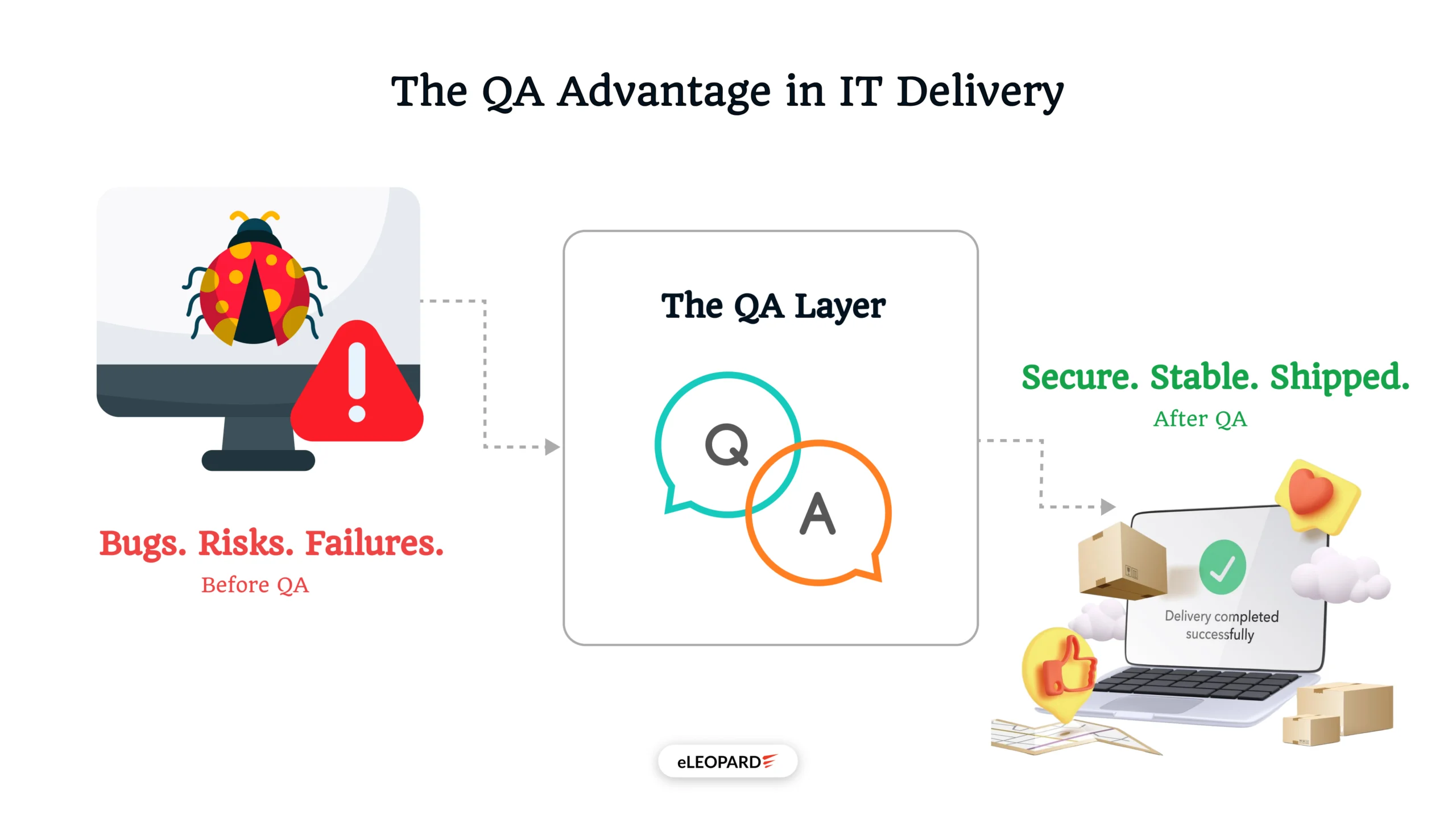
In today’s competitive digital landscape, organizations are under constant pressure to deliver innovative products faster while maintaining exceptional quality, security, and customer experience. Whether launching a new customer platform, modernizing legacy systems, or implementing enterprise-wide digital transformation initiatives, project success is no longer determined solely by development speed. It is increasingly defined by how effectively quality assurance (QA) and next-generation technologies work together throughout the project lifecycle.
For CEOs, CTOs, CIOs, and business leaders, the challenge extends beyond software delivery. It involves reducing operational risks, optimizing investment returns, accelerating time-to-market, and ensuring that technology initiatives support long-term business objectives. Modern QA, powered by next-generation technologies such as Artificial Intelligence (AI), automation, analytics, cloud computing, and intelligent monitoring, has become a strategic business function that enables organizations to achieve these goals.
The Business Impact of Quality in IT Projects
Technology failures can result in significant financial losses, reputational damage, regulatory penalties, and customer dissatisfaction. As digital ecosystems become more complex, traditional testing approaches are no longer sufficient to manage these risks.
Modern QA provides business leaders with:
- Greater confidence in digital transformation initiatives.
- Reduced project and operational risks.
- Improved customer experience and satisfaction.
- Faster and more predictable release cycles.
- Better regulatory and compliance outcomes.
- Increased return on technology investments.
Organizations that embed quality throughout the development lifecycle are better positioned to deliver consistent business value while minimizing costly disruptions.
The Evolution of QA from Cost Center to Strategic Enabler
Historically, QA was viewed as the final checkpoint before software deployment. Today, leading organizations recognize QA as a strategic function that drives business performance.
Modern QA enables:
Faster Decision-Making
Continuous testing and real-time quality insights provide leadership teams with greater visibility into project health, allowing informed decisions throughout the development process.
Risk-Based Prioritization
Advanced QA practices focus testing efforts on critical business processes, customer-facing applications, and high-risk areas that directly impact revenue and operations.
Business Continuity
By identifying vulnerabilities, performance bottlenecks, and integration issues early, organizations can prevent disruptions that affect customers and stakeholders.
How Next-Gen Technologies Are Transforming QA
Artificial Intelligence and Machine Learning
AI-powered testing platforms are transforming quality assurance by enabling intelligent test generation, predictive analytics, and defect forecasting.
Benefits include:
- Faster identification of potential failures.
- Improved test coverage.
- Reduced manual effort.
- More accurate risk assessments.
- Early detection of quality trends.
For executives, AI-driven QA translates into reduced project uncertainty and improved delivery confidence.
Intelligent Test Automation
Automation has evolved beyond repetitive regression testing. Modern automation frameworks support end-to-end business process validation across complex digital ecosystems.
Key advantages include:
- Accelerated release cycles.
- Consistent testing quality.
- Reduced operational costs.
- Improved scalability across projects.
- Faster validation of business-critical functions.
Organizations leveraging automation effectively can significantly improve delivery speed without compromising quality.
Cloud-Based Testing Environments
Cloud technology enables organizations to test applications across multiple devices, platforms, geographies, and user scenarios at scale.
Business benefits include:
- Reduced infrastructure investment.
- Faster environment provisioning.
- Greater testing flexibility.
- Improved global user experience validation.
- Enhanced collaboration across distributed teams.
Cloud-enabled QA supports modern enterprises operating in increasingly global and digital markets.
Data Analytics and Quality Intelligence
Advanced analytics provides actionable insights into quality trends, project performance, and operational risks.
Leadership teams can leverage quality intelligence to:
- Monitor project health.
- Track quality KPIs.
- Forecast release readiness.
- Optimize resource allocation.
- Improve strategic planning.
Data-driven QA enables organizations to move from reactive issue management to proactive quality governance.
Aligning QA with Business Objectives
World-class IT projects are not measured solely by technical success. They are evaluated based on business outcomes.
Effective QA strategies align with key business objectives such as:
Revenue Protection
Reliable digital platforms minimize service disruptions, transaction failures, and customer churn.
Customer Experience Excellence
Quality-focused organizations consistently deliver seamless user experiences that strengthen customer trust and brand loyalty.
Regulatory Compliance
Industries such as finance, healthcare, insurance, and telecommunications face increasing regulatory requirements. Robust QA practices help organizations maintain compliance and reduce legal exposure.
Digital Transformation Success
As enterprises modernize systems and adopt emerging technologies, QA ensures transformation initiatives deliver intended business value while minimizing operational risks.
Executive-Level Benefits of Modern QA Investments
When integrated strategically, QA delivers measurable business outcomes.
Reduced Cost of Failure
Identifying defects early significantly lowers remediation costs and prevents expensive production incidents.
Increased Operational Efficiency
Automation and intelligent testing reduce manual effort, allowing teams to focus on innovation and strategic initiatives.
Faster Time-to-Market
Continuous quality practices enable organizations to release products and services more rapidly while maintaining reliability.
Improved Stakeholder Confidence
Reliable delivery processes increase confidence among customers, investors, partners, and executive leadership.
Stronger Competitive Advantage
Organizations that consistently deliver high-quality digital experiences gain market differentiation and customer trust.
Building a Future-Ready Quality Strategy
To maximize business value, leadership teams should focus on:
- Embedding quality throughout the software development lifecycle.
- Investing in AI-powered testing capabilities.
- Expanding intelligent automation initiatives.
- Leveraging cloud-based testing infrastructure.
- Establishing quality metrics aligned with business outcomes.
- Promoting collaboration between business and technology teams.
- Using analytics to support strategic decision-making.
A future-ready quality strategy positions organizations to adapt quickly to evolving market demands while maintaining operational excellence.
Conclusion
In the era of digital transformation, quality assurance is no longer a support function; it is a business-critical capability. Organizations that combine modern QA practices with next-generation technologies can reduce risk, accelerate innovation, improve customer experiences, and maximize the return on technology investments.
Frequently Asked Questions
Why is Quality Assurance (QA) important for business leaders and not just IT teams?
QA directly impacts business outcomes by reducing operational risks, preventing costly system failures, improving customer experiences, and ensuring that technology investments deliver expected returns. For executives, QA serves as a strategic tool for protecting revenue, reputation, and long-term growth.
How do next-generation technologies improve project success rates?
Technologies such as Artificial Intelligence (AI), Machine Learning (ML), intelligent automation, cloud computing, and advanced analytics enable organizations to identify risks earlier, accelerate testing cycles, improve decision-making, and deliver higher-quality products faster. These capabilities significantly increase the likelihood of project success.
What business risks can be reduced through modern QA practices?
Modern QA helps mitigate several critical risks, including:
- System outages and service disruptions.
- Security vulnerabilities.
- Compliance and regulatory failures.
- Customer dissatisfaction and churn.
- Revenue loss from application defects.
- Delays in product launches and digital transformation initiatives.
How does AI-powered QA create value for organizations?
AI-powered QA improves efficiency by automating repetitive tasks, predicting potential defects, optimizing test coverage, and providing actionable insights through analytics. This allows organizations to reduce costs, accelerate delivery timelines, and improve software reliability.
Can QA accelerate digital transformation initiatives?
Yes. Effective QA ensures that new technologies, integrations, and digital platforms function as expected before deployment. This reduces implementation risks, supports business continuity, and enables organizations to achieve digital transformation objectives more confidently and efficiently.
What role does automation play in delivering world-class IT projects?
Automation enables continuous testing, faster validation of business processes, and consistent quality across multiple releases. It helps organizations shorten development cycles while maintaining high standards of performance, security, and reliability.
How can executives measure the ROI of QA investments?
Key performance indicators (KPIs) include:
- Reduction in production defects.
- Faster time-to-market.
- Lower maintenance and remediation costs.
- Improved customer satisfaction scores.
- Increased application availability and performance.
- Reduced compliance and security incidents.
These metrics demonstrate the business value generated through quality-focused initiatives.
What should organizations prioritize when building a future-ready QA strategy?
Organizations should focus on:
- AI-driven testing capabilities.
- Intelligent automation frameworks.
- Cloud-based testing environments.
- Continuous testing practices.
- Data-driven quality analytics.
- Alignment of QA metrics with business objectives.
- Cross-functional collaboration between business and technology teams.
Is QA still relevant in Agile and DevOps environments?
Absolutely. In Agile and DevOps environments, QA becomes even more critical. Continuous testing and quality monitoring ensure that rapid development cycles do not compromise reliability, security, or customer experience.
How does QA contribute to customer experience and brand reputation?
Every digital interaction shapes customer perception. High-quality applications reduce errors, improve usability, enhance performance, and create seamless user experiences. This strengthens customer trust, increases loyalty, and protects brand reputation in competitive markets.
