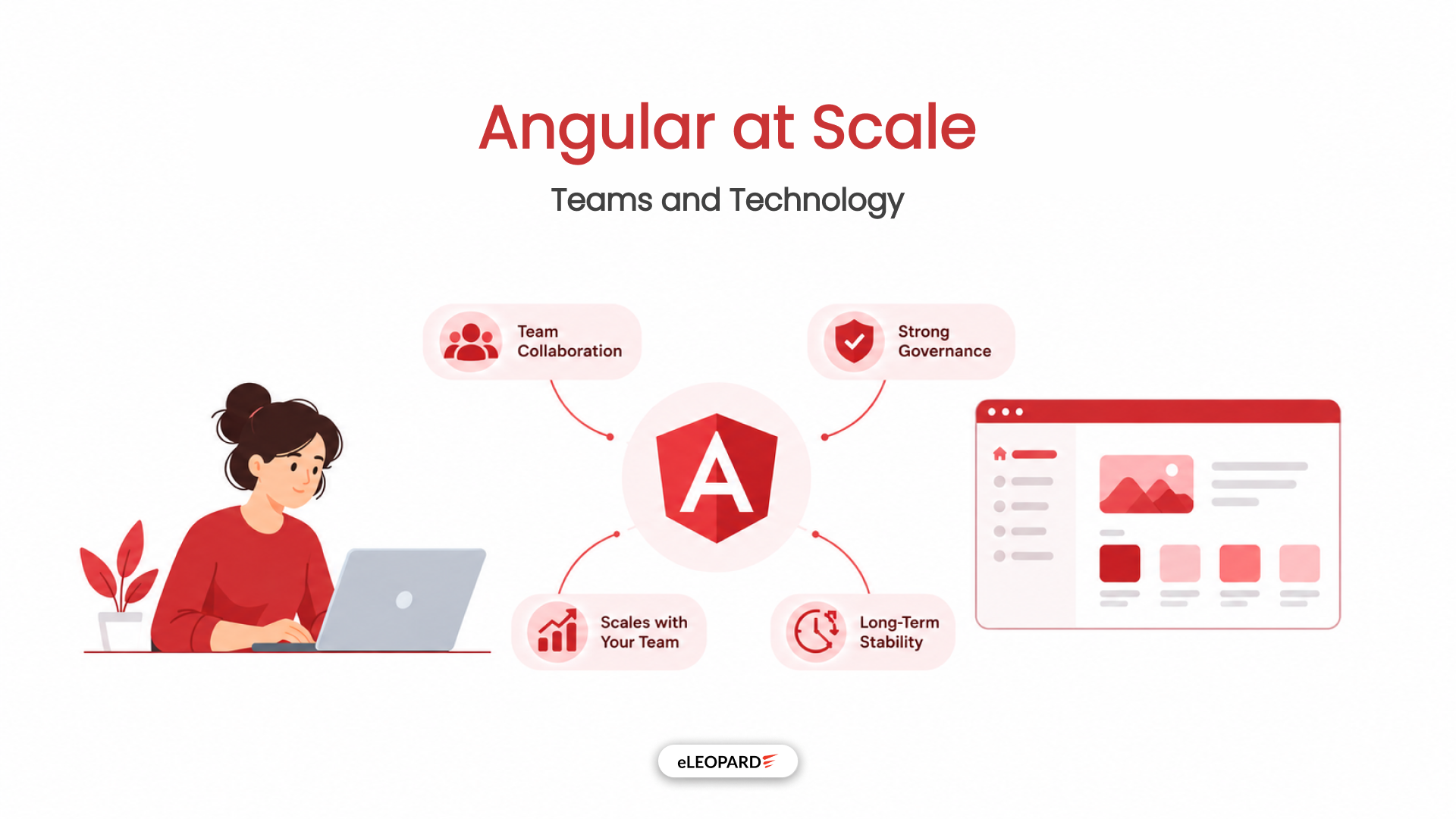
Opinions about frameworks are cheap. What actually matters at 200,000 lines of code, a dozen teams, and a five-year roadmap is a lot narrower than a blog debate — and it’s exactly where Angular quietly wins.
Every framework looks good in a demo. The differences that matter show up two years in, when the codebase has forty contributors instead of four, the product has shipped through three reorganizations. That’s the environment we build in at eLEOPARD Solutions, and it’s why, for large-scale applications, we keep reaching for Angular.
This isn’t a loyalty pitch. React and Vue are excellent tools, and we use both when the project calls for it — a marketing site, a small internal dashboard, a prototype that needs to move fast and stay disposable. But when the ask is a large, long-lived, multi-team application — the kind with dozens of routes, shared design systems, strict compliance requirements, and a roadmap measured in years — Angular’s opinions stop being a constraint and start being the thing that keeps the project coherent.
A framework, not a pile of decisions
The single biggest cost on a large codebase isn’t writing new code — it’s the friction of understanding code someone else wrote six months ago. Angular reduces that friction by design. Routing, dependency injection, forms, HTTP, testing utilities, and build tooling all ship as one coherent platform with one way of doing most things. A new engineer who has worked on any Angular app before can be productive in your codebase within days, because the module structure, the service layer, and the component conventions are recognizably the same everywhere.
Compare that to the typical large React codebase, where every team has independently chosen its own router, state library, form library, and folder convention. None of those choices are wrong in isolation. Stacked across a five-year-old application with turnover, they compound into an architectural problem.
Angular’s opinions aren’t a constraint on a large team — they’re the thing that keeps forty engineers writing code that looks like it came from one team.
TypeScript-first, not TypeScript-optional
Angular was rebuilt around TypeScript, not retrofitted for it. Every API — components, services, forms, the router, dependency injection — is designed with types as a first-class citizen, not bolted on with community-maintained `@types` packages of varying quality. On a large application, this pays off in exactly the place it needs to: at the seams between teams, where a change in one module’s contract should fail loudly at compile time in every module that depends on it, not silently at runtime in production.
Where the platform earns its keep
Dependency injection
A hierarchical DI system built into the framework, not a pattern teams have to invent. Swapping implementations for testing, feature flags, or multi-tenant behavior is a provider change, not a refactor.
The Angular CLI
Scaffolding, build, test, and lint configuration that’s consistent across every app in the org. New repos don’t start with a week of tooling decisions.
Signals & change detection
Angular’s move to signals and fine-grained reactivity (accelerated in recent major versions, including Angular 21) gives large component trees predictable performance without the manual memoization gymnastics common elsewhere.
Enterprise-grade forms
Reactive forms with typed groups and built-in validation handle the deeply nested, conditionally-rendered forms that enterprise software is full of — without a third-party dependency.
Built for teams, not just for code
Large-scale isn’t only a technical property — it’s an organizational one. Angular’s module boundaries, standalone component APIs, and strict CLI-enforced project structure make it straightforward to split a monolith into ownership domains: one team on billing, another on scheduling, another on the shared component library. Because the framework itself enforces a shape, code review catches structural drift early instead of three sprints later.
This is also where Angular’s backing matters. It’s maintained by Google with a published, predictable release cadence and long-term support windows — a material consideration when you’re planning a migration roadmap for an application that needs to still be running, and still be upgrade-able, in 2026.
The pragmatic case, not the purist one
We wrote recently about Angular 21 as a pragmatic step forward — signals maturing, zone-less change detection becoming viable, and the framework continuing to simplify itself rather than accumulate ceremony. That trajectory matters here too. Angular’s recent history isn’t chasing novelty; it’s steadily removing the friction that used to be the honest criticism of the framework (verbose boilerplate, RxJS-everywhere, heavier bundles). The core strength for large applications — structure, types, and a maintained platform — was never in question. What’s changed is that the day-to-day experience of writing it has gotten dramatically better too.
When Angular is the right call
- Multiple teams, one codebase. Shared conventions matter more than any individual team’s preference.
- A multi-year roadmap. You need a framework with a predictable upgrade path, not one you’ll be rewriting off of in eighteen months.
- Regulated or high-stakes domains. Type safety and test-ability aren’t nice-to-haves when correctness is audited.
- Large, complex forms and data workflows. Angular’s reactive forms and RxJS integration were built for exactly this.
No framework is the right answer for every project, and we don’t pretend otherwise — plenty of the work we ship at eLEOPARD Solutions isn’t Angular. But when a client comes to us with a genuinely large-scale application — the kind that will outlive its first team of engineers — Angular is very often where we land, not out of habit, but because its opinions are the ones a project that size actually needs.
